
HOME | ABOUT US | MEDIA KIT | CONTACT US | INQUIRE
HOME | ABOUT US | MEDIA KIT | CONTACT US | INQUIRE
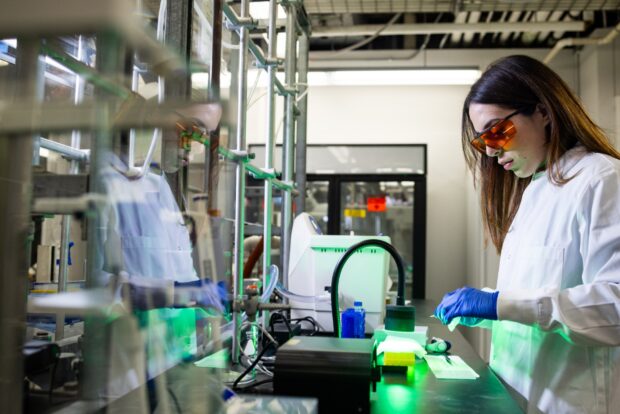
UMKC and Children’s Mercy's new agreement allows for faster pathways for Ph.D. students to collaborate with hospital researchers. Photo credit: The University of Missouri-Kansas City.
Posted May 28, 2026
The University of Missouri-Kansas City and Children’s Mercy announced they have entered into a new agreement to allow Ph.D. students to collaborate with hospital researchers.
Under the new agreement, the need for individual, project-by-project administrative approvals has been removed, and doctoral students can readily engage with Children’s Mercy research teams, according to a release. Furthermore, researchers at Children’s Mercy have faster access to talent across natural sciences and the UMKC School of Science and Engineering.
This new agreement was developed following an experience involving a student and Dr. Gerald Wyckoff, chair of pharmacology and pharmaceutical sciences and a UM System Curators’ Distinguished Professor. These individuals were conducting a Children’s Mercy research project that ultimately got approval, albeit through a “slow and complex” process.
Wyckoff then worked closely with two individuals from the Children’s Mercy Research Institute: Dr. Mark Hoffman, chief research information officer and Dr. Laura Ramsey, section chief of individualized therapeutics, who created the framework for this new agreement.
“Science is a team sport,” Wyckoff said in the release. “This is a really effective team because we’ve got people who are motivated on both ends of the spectrum.”
The agreement also establishes regular joint reviews between UMKC and Children’s Mercy, allowing leaders and researchers to identify emerging areas for collaboration proactively.
“True innovation happens through strong collaboration,” Dr. Sumeet Dua, UMKC vice chancellor for research and innovation, said in the release. “By aligning the strengths of UMKC and Children’s Mercy, we are putting our students at the forefront of discovery and empowering them to fast-track research from the lab directly to the families who need it most.”