
HOME | ABOUT US | MEDIA KIT | CONTACT US | INQUIRE
HOME | ABOUT US | MEDIA KIT | CONTACT US | INQUIRE
The co-founder of two monolithic wealth-management enterprises reflects on changes that affect differing generations of investors, emerging trends in retirement living, and the sector’s vibrancy.
 Q: Most projections put the Great Wealth Transfer at roughly $84 trillion through 2045, with Baby Boomers driving the bulk of it. How is that actually unfolding on the ground right now?
A: It’s interesting, thinking about the advisers we work with and the people we serve, most of them are in those two generations, Boomer and Silent, and we’re really making a difference for them. From our standpoint, from both business growth and the people we serve, the value add we’re providing is accelerating in both the numbers of people we serve and unbelievable growth with advisers all over the country. I think it’s because when we look at the group of Boomers and even Silent, both have a handful of problems, or opportunities, however you look at it, with things going on pretty consistently.
Q: What are some of those?
A: No. 1: They need a real plan that meets expectations. They know they need to spend some, save, might give some, might want to transfer some to children and grandchildren. Do you have a plan that allows you to do all that? No. 2: I think the cost and challenge of health care, home health, long-term care-—all of that is really expensive. If they can get that insured and feel confident, it allows them to put their money to work so they can also have great experiences in retirement. Tax planning is an ongoing conversation; most everyone is willing to pay their fair share, but for a lot of us, it’s fairly complicated. You want to be able to pay the right amount, but not the wrong amount, and plan around that. If you compared the Boomers vs. the Silent, the Boomer is still in the go-go phase; there’s a lot of energy left in that group. They are asking themselves questions about this awesome nest egg—they’ve got investments in stocks and bonds, but now they’re also asking, how can I invest in the experiences that help define retirement lifestyle? My mom and dad are Boomers who were able to spend $1,500 to see the Argentina game in the World Cup. So at 75, they know they saw Lionel Messi play one of his last World Cup games. That’s part of the goal now for many. All the other things have been taken care of, so I think in that world, investing today is also about experiences. I believe more and more people looking to their retirement years need to be asking themselves about that. What our AE advisers believe, and we believe, and clients do, too, is that the value of planning is not just about the return on your money. I think it really is an extension of, and value add for, your lifestyle. Often in this industry, there’s too much focus on the spreadsheet, when the focus should be on the personal experience.
Q: What’s needed to help clients ensure that higher quality of life?
A: You have to be real. Too often, that balancing becomes generalized: “If you’ve seen one retiree, you’ve seen them all,” and it’s less about what personal plan you can create. Some people have saved more, some less; some have pensions, some do not. Some had real-life challenges that changed their plans. Some are investing in grandkids in ways earlier generations might never have planned on being able to do. In general, yes, I do think the wealth overall of retirees is more. They have the excess, whether the Silent or Boomers. Maybe they saved in a 401(k), and if you look at the markets over 20 years, that method has been working really well—generated a lot for them, with their returns made over time. The key to the whole deal is, as an individual, what’s your plan and how will it meet your expectation for what you want in retirement, so that you can get what you want and desire out of it.
Q: Roughly 15 million members of the Silent Generation are still living, and a meaningful share of dynastic wealth still sits at the very top of the age pyramid. Has the bulk of the transfer essentially run its course?
A: They are still very active. If nothing else, I think they are willing—that group, they are older, now in their 80s and 90s, and even 100 or more, so people are living longer. When I gave the example of things they are more interested in, maybe those areas include tax savings, maybe not. For some, that’s not the top priority. Are they really focused on retirement income and rate of return? Not as much. Are they interested in how they are positioned for the cost of long-term care or home health, and how their wishes for their estate are carried out? I think they absolutely are. Some still have unbelievable health—they’re still rocking and rolling—but many are slowing down. But as we coach them on experiences, they are also thinking about kids and grandkids. Maybe giving money away and seeing that the kids get that Disney World trip, or paying for college to make a difference. The point is, the goals or dynamic of that planning shifts with the older clients vs. younger retirees.
Q: As more clients shift from accumulation into transfer mode, how is succession planning reshaping the way portfolios are actually built—asset location, liquidity, concentration risk, the role of trusts, life insurance, and tax-aware vehicles?
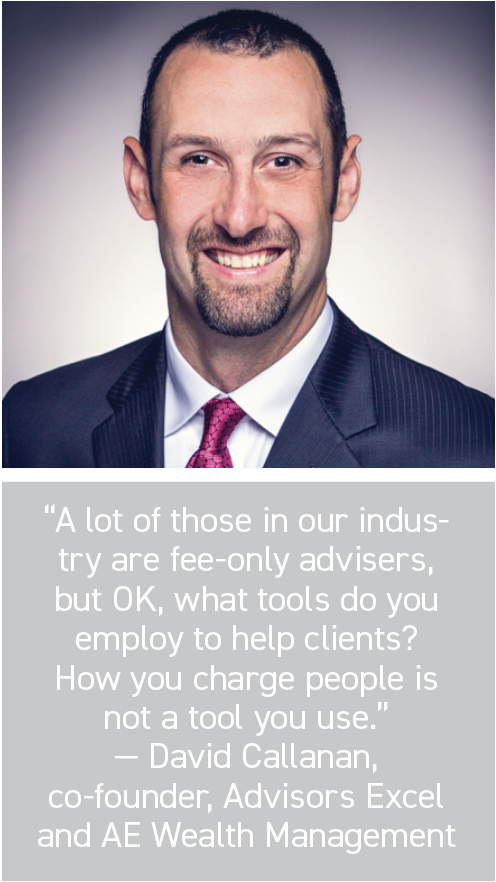
A: The people 55–90 are who we’re here to serve. When you know your demographic, you know the tools you should have. If I build a home, the tools look different if it’s a mobile home vs. something near Downtown Kansas City. As retirement specialists, we need a broader-based tool kit. A lot of those in our industry are fee-only advisers, but OK, what tools do you employ to help clients? How you charge people is not a tool you use. As retirement planners, we can use stocks, bonds, ETFs or similar tools there, but in our business you tend to be more focused on risk mitigation, safe or conservative income solutions. We tend to want to make sure to limit health-care risk, for one. In old age, people want access to their money, because they don’t have the income from a job. Clients should really be intentional, to be sure they are the builder you want. Are they really focused on retirement?
Q: Leading-edge Gen Xers are now in their late 50s and early 60s—peak years for selling closely held businesses. Are you seeing a noticeable uptick in advisory work tied to business exits?
A: There are tons of business owners in that range, definitely needing service from the right team. I will say when people—business owners—get to that point where they are considering retirement with a closely held company, the team of experts you assemble is the most important thing. Often, they may not have put the right team together. As they reach retirement age, I think they would want in those last five years to really build a team of experts. They need business brokers; many have never met with one in their lives. They need an attorney who specializes in business transitions. For some, the last time they worked with an attorney was when they set up their LLC 30 years ago. They need a tax specialist, specializing in business ownership. And they need an investment professional. That group, they are the ones that really can help build a plan. There’s one other side, that’s talked about the least: all four of those give tactical tools, the logical things, but too often they are forgetting the emotional side: “I have unbelievable feelings about my clients, my teammates, and the worth of life for me is being a business owner and entrepreneur.” So you need a coach who is not only talking through the tactical, but the emotional side, and we do our best to help put those teams together.
Q: Industry data has long suggested that something like 70 to 80 percent of heirs change advisers within a year or two of inheriting. What are AE Wealth and its advisers doing to retain second- and third-generation relationships?
A: You used a couple of words that are very important. No. 1, I don’t think it’s that the next generation isn’t loyal; it’s that they don’t have a relationship. That’s very, very important. Too often, advisers focus on the client—the person in front of them, the one you’re working directly with. Many choose not to invest the time into the full family. We want to create experiences for that full family: education, retirement, entertainment, plans to engage the next generation in family meetings. So the advisory role has to change—not just working with the retiree in front of you, but engaging the whole family, and that will change over time; that will be a challenge. If the next gen doesn’t want to engage, that’s their choice, but the role the adviser needs to play is to serve the family.
Q: Greater Kansas City has quietly become a real wealth-management hub—Mariner, Creative Planning, Commerce Trust, UMB, etc., and AE Wealth itself with major AUM/AUA growth. How would you characterize the competitive health of the regional sector right now?
A: One thing I do believe is it’s more about the clients than the business itself. In the Midwest—I was reading a book by Chase Koch (of Wichita’s Koch Industries), and people would ask him for years, why stay in Wichita? He said it’s because we’ve got the farm club here in Kansas, to use a baseball analogy. From a business perspective, we have hard-working people. Service-first businesses thrive in the Midwest, whether it’s AE Wealth, Creative Planning, Mariner or a host of others. We’re taking what I call Kansas Principles and applying them across the U.S., creating exponential growth. We’re not just growing in KC or the Midwest; we’re growing all over the United States. We’re taking a little of that farm club, or a little bit of Kansas, and putting that in Arizona, Florida, California or Massachusetts. We’re finding that a family-first, client-first culture is resonating with families across the U.S., and we generally believe our advisers are client-experience advisers, and because of that, we are thriving.
Q: Beyond the transfer conversation, simply put: a huge cohort of existing clients is aging into drawdown over the next decade. That shifts the adviser’s job from accumulation to decumulation—sequence-of-returns risk, longevity, health-care costs, Medicare and Social Security optimization. How is that shift reshaping the typical client engagement?
A: It comes down to generalist vs. the specialists. The generalist is the financial planner; the specialist is the retirement planner. If you’re equipped to understand that, you will find you can deliver the right value. The sequence-of-returns risk matters, but for a 35-year-old, maybe not that much. To a 70-year-old, it matters a ton. With shorter time horizons, you don’t have the ability to take the same risk as before. You have to help them create a plan to create something almost like a pension, to have taken care of the health risk, so you don’t have to worry about the $100,000 cost of long-term care or assisted living. When I got into this business, my 55-year-old dad was retiring. He had an adviser who might have just said, buy these mutual funds, and if they didn’t turn out fine, that wasn’t his problem—it was my dad’s. And I thought there has to be a better way. We want to over serve that family with a specialized focus.
PUBLISHED JULY 2026