
HOME | ABOUT US | MEDIA KIT | CONTACT US | INQUIRE
HOME | ABOUT US | MEDIA KIT | CONTACT US | INQUIRE
Key executive in the regional hospitality sector takes the measure of FIFA World Cup impact and what’s in store for a vital employment sector that drives commerce on a broad scale.
 Q: After FIFA’s recent bulk room cancellations for World Cup reservations, what’s your honest assessment of how that arrangement was structured?
A: I think the big headline is that FIFA released 75 percent—that’s the number we’ve seen a lot—of the originally contracted room blocks. It’s not uncommon for major events like the World Cup to involve complex agreements negotiated years in advance, with built-in review and cutoff dates where a percentage of rooms can be released without penalty. That framework exists for good reason—no one can predict demand with perfect precision that far out. In this case, the volume released was certainly more than expected, but context matters.
Q: What does that experience say about the leverage—or lack of it—that host cities have when negotiating with an organization like FIFA?
A: What makes FIFA uniquely difficult to forecast is that it only happens every four years and rotates to vastly different parts of the world each time. With most major events, we have recent comparable history—similar host cities, similar demand patterns—to inform our planning. That simply doesn’t exist for FIFA. Add to that the current political climate and its impact on international travel, and you have a set of circumstances that made accurate forecasting genuinely difficult, not just for hotels, but for FIFA itself.
Q: What does that experience say about the challenge of Kansas City pursuing and landing such mammoth events?
A: The broader takeaway is that hosting an event like this requires flexibility and close collaboration between hotels and the organization, communicating regularly so no one is surprised when the review period comes around to release rooms. From the hotel perspective, our focus is on this being a positive experience and embracing the opportunity we do have—hotels are filling up on match days. I don’t think anybody questions or doubts that the World Cup will have a lasting impact on our host city’s notoriety and give us a chance to be put on a stage like never before.
Q: And your longer-term expectations of how this affects the market?
A: What we’re seeing—and what FIFA prepared us to expect—is that this World Cup visitor is a very last-minute planner. We’ve seen booking pickup happen much closer to the event than it normally would for a convention. In addition, especially with KC being centrally located, we’re seeing drivers coming from within about a 1,200-mile radius—Nebraska, Oklahoma, areas like that—making a vacation out of it, even if they’re not going to games. Fan Fest is part of that draw as well.
Q: Beyond FIFA, Kansas City hotels were already navigating a complicated summer before that news broke. Where does the local sector stand heading into the back half of 2026?
A: As far as this year goes, despite the attention FIFA has captured, we had a great Q1 and Q2—the first half was very positive. Each hotel has a different experience, but speaking as a whole for KC, we performed very strongly in the first and second quarters, and while we’re seeing some softness in Q3 and Q4, that still holds real opportunity. Good events will create compression in the back half, and the hope is for hotels to stay aggressive with short-term business. Even more positive is our pipeline into 2027 and beyond—our next few years have very strong momentum. Our city has done a great job recently investing in and focusing attention on what attracts visitors, leaning into those strengths to effectively compete against peer cities.
Q: How has hotel construction in recent years changed the competitive dynamics among properties here?
A: It does create some competition among the hotels in this market. We’ve had a lot of development over the past several years that helps us compete for larger groups. At the same time, building new hotels is a sign of confidence in the destination’s future. The additional inventory allows KC to pursue larger events, accommodate more visitors, and grow the convention business we already have. We’re still in the process of absorbing that growth, but KC has built a strong pipeline of future business.
Q: How would you characterize the efforts of hotels here to manage aggressive pricing vs. the risk of damaging the region’s hospitality brand?
A: It’s definitely a balancing act. Hotels have a responsibility to maximize revenue during high periods of demand, but they’re always mindful that long-term success depends on a positive reputation—the affordability and perception that those rates create among leisure guests and meeting planners. KC has historically done a good job striking that balance. The market builds a significant amount of repeat business—whether convention, corporate travel, sporting events, or leisure—and hotels understand that today’s pricing can affect future bookings and influence what meeting planners do down the road. With the World Cup’s unique demand patterns, it really challenges hotels to stay nimble and adjust as needed. Rates moved based on supply and demand, mixing peak pricing on match days with softer periods in between. There’s nothing to suggest KC lost sight of maintaining rate integrity through it.
Q: How is Kansas City performing in the convention and tourism segment right now, and what’s the outlook for the back half of 2026 and into 2027?
A: Definitely more convention business. That remains an incredibly important part of the KC hotel industry—not only for Downtown properties, but also around the metro, because it creates compression and fills hotels outside of downtown too. The back half of 2026 is softer, but that’s not unique to us—it’s just the sentiment around travel right now, and a lot of cities are navigating that same economic uncertainty. Looking ahead to 2027 and beyond, we’re in a strong position. It’s also important to remember our fundamentals—we’re centrally located, known as affordable, and Midwest hospitality is a real thing. People love coming here, and once they’re here, they come back. We’re definitely getting looked at for different types of conventions now.
Q: Tell us a bit about the relationship between Visit KC and the hotel community.
A: One of our strongest selling points is the relationship between Visit KC and the hotels. It’s definitely a competitive advantage—when meeting planners cite us as a convention location, they notice that synergy within the hospitality community. KC does that extremely well. We’re all working toward the same goal: attracting visitors and driving economic impact. As we look at the next generation of bookings, we want to build on the momentum we have now—momentum created by large groups that put us on the world stage, like the World Cup. We’re also making sure city leaders understand the value of investing in that kind of visitor infrastructure, because it generates real economic impact.
Q: Work force has been a persistent challenge across hospitality since the pandemic—recruiting, retaining, and training front-line staff. Where does the Kansas City market stand on that issue today compared to two or three years ago?
A: We’re doing better than we were a few years ago. One of the biggest focuses of ours as an association is to help build that funnel—that work-force pipeline—for the industry. Every hotel would love a larger pool, but staffing levels have leveled off compared to right after the pandemic, when things were dire. What excites us most as an association is the future—the students who are curious about what’s available and what hospitality looks like as a career path. So many people aren’t aware of the different opportunities in hospitality, and the tremendous amount of flexibility and upward mobility it provides—there’s interest in sales, marketing, finance and HR, all of it encompassed in this industry. It’s one of the few where hard work, attitude and experience can open as many doors as a university degree. We’ve been spending more time engaging with high schools, colleges, and workforce development partners—annual job fairs, internships, student presentations, and scholarships for those pursuing hospitality as a career.
Q: When you look at the national picture, what macro forces concern you most for the health of the hotel sector here over the next 18 to 24 months?
A: The uncertainty around interest rates, construction costs, and labor costs—all of those things influence the industry in different ways. Higher costs affect new development and day-to-day operations. Consumer sentiment affects how travelers make decisions, and the industry feels the economy as a whole. The benefit KC has is a diverse mix of demand drivers—not just convention business, not just sports.
Q: Short-term rentals through platforms like Airbnb and VRBO were expected to fundamentally disrupt traditional lodging. How has that actually played out in this market?
A: In terms of inventory, short-term rentals in KC are relatively modest. There was an increase tied to the World Cup, due to several local decisions and an expedited approval process. My honest opinion is that they serve a different kind of traveler—extended-stay travel, groups, families, or people wanting a kitchen. Hotels have never been focused on limiting consumer choice. Our priority is leveling the playing field—making sure everyone adheres to the same operational and safety standards.
Q: When competing for a major convention or conference, who are our rivals, and what does this city need to do better to consistently win that business?
A: It varies. In the convention space, destinations are always keeping up with the Joneses. KC is generally lumped in with or compared to similarly sized destinations—places with comparable accessibility and convention center offerings, like Nashville, Indianapolis, and Cincinnati—but KC is very competitive with those and others. With all the development we’ve done over the past several years, this is a great opportunity to capitalize on that and continue investing to remain competitive.
Q: If you could identify one structural change that would strengthen the long-term health of the hospitality sector in Greater Kansas City, what would it be?
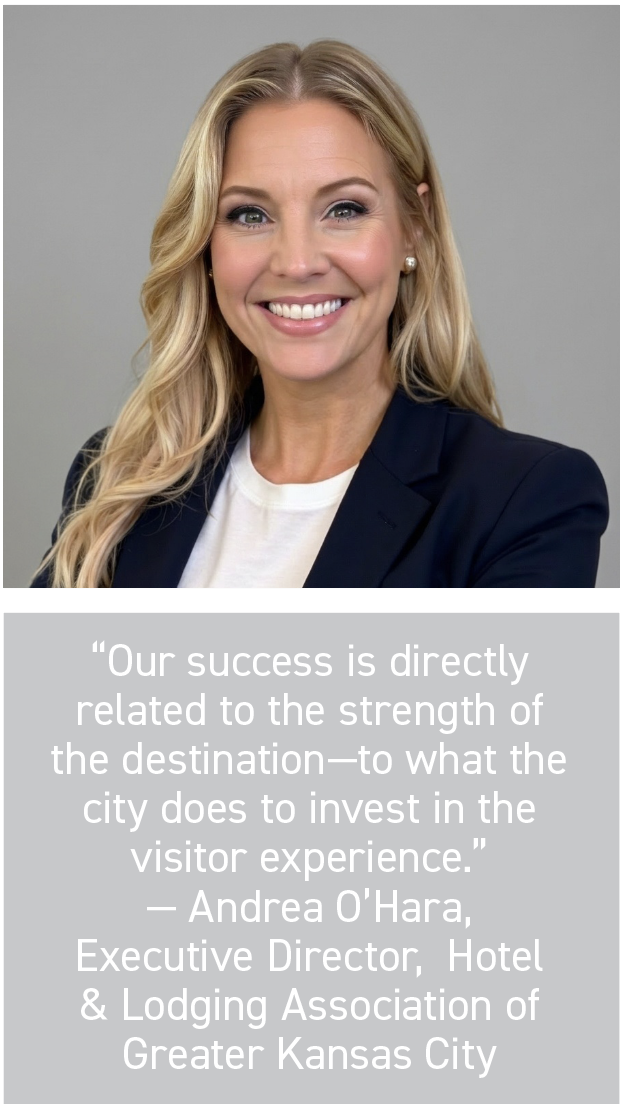
A: This industry doesn’t operate in a vacuum. Our success is directly related to the strength of the destination—to what the city does to invest in the visitor experience. The destinations that consistently attract visitors are the ones that recognize tourism as an economic driver—and that benefits not just the hospitality industry, but residents too, because it helps keep taxes lower through the economic activity that business drives. We need to keep investing, and if KC remains committed to enhancing the experience and investing in those assets, it can thrive for many years. We have the wind at our back—the momentum is there. We just need to stay real about it.