
HOME | ABOUT US | MEDIA KIT | CONTACT US | INQUIRE
HOME | ABOUT US | MEDIA KIT | CONTACT US | INQUIRE
The World Cup gave Kansas City its biggest moment and may reset the civic vision. Now comes the harder question of what it’s worth.
On June 16, Kansas City started to test the math.
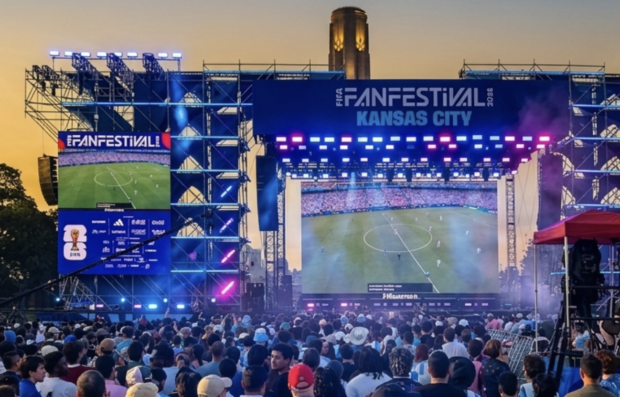
By 6 p.m., Power & Light District patios were three deep in Argentine blue and Algerian green, with a smaller scatter of jerseys from teams not even playing that night—fans who came simply because Kansas City is where the World Cup happened to be. Streetcars ran past capacity. The FIFA Fan Festival on the National WWI Museum lawn opened 10 minutes early because the line had already wrapped the block. At 8 p.m., Lionel Messi and the defending champions took the field at what FIFA has rebranded Kansas City Stadium.
What followed was World Cup history. Messi, three weeks removed from a hamstring scare with Inter Miami, scored all three goals in Argentina’s 3-0 win over Algeria—his first World Cup hat trick in a 20-year international career, and the trio of goals that tied Germany’s Miroslav Klose for the all-time men’s tournament scoring record. All 69,045 seats were filled. The match put Kansas City in the global sports conversation in a way few moments in the city’s history have.
Two nights later, a nearly similar crowd filled the stands for the first-round tie between Ecuador, representing a nation of 18 million people, and Curacao, with a population roughly the size of Olathe. In World Cup parlance, that 0-0 outcome was a source of national pride for the Caribbean island country.
For KC2026 board vice president Neal Sharma, who has overseen the organizational build toward this moment for three years, these events have clarified something that the numbers couldn’t have predicted. “We understood that it would happen,” Sharma said, “but we couldn’t put a finger on the emotions we would have when KC volunteers unfurled the Argentine and Algerian flags on the field at Arrowhead. So many folks connected with this got goosebumps.”
Mark Jorgenson, who has served as KC2026 board president since last July, put it more simply after attending the opener: “It was incredible—a lot of singing, dancing, and it didn’t hurt that Messi got that hat trick.”
Those moments were real. What’s harder to settle, now that the tournament is reaching its midpoint, is how thoroughly the broader economic script will play out.
Those promises carry a specific price tag: an oft-cited estimate of $653 million in direct economic impact, a figure repeated in nearly every KC2026 release, council presentation and ribbon-cutting since organizers first floated it. Divided across six matches, that suggests roughly $109 million of impact per game—a figure that may actually undersell what a sold-out Argentina match generated at the gate alone, given secondary-market ticket prices well into the hundreds and FIFA’s official parking at $175 per vehicle for group-stage fixtures. Add 650,000 total visitors—enough to outnumber the city’s own population—and a 26-day run that includes a Round of 32 games and a quarterfinal, and the pitch writes itself: global exposure, a stadium-to-storefront surge, a return on roughly $200 million in combined public investment.
The question is how much of that surge escapes the perimeter.
Start with hotels, the indicator business leaders watch most closely. An American Hotel & Lodging Association survey released in early May found Kansas City trailing every other U.S. host market, with 85 to 90 percent of operators reporting booking pace below what they’d expect in an ordinary June or July, let alone a World Cup month. On top of that came FIFA’s own room-block cancellations—in some markets reaching 70 to 95 percent of originally contracted inventory—alongside visa friction and a shorter, more last-minute booking pattern among the international travelers Kansas City had been counting on.
The doubt isn’t confined to hotel operators. Kansas lawmakers spent early 2026 sparring over whether the state should contribute $20 million or more toward a tournament whose matches all take place across the state line in Missouri, with the House speaker publicly questioning why Kansas tax dollars should leave the state. In Lawrence, where Algeria’s national team established its base camp, tourism officials acknowledged just weeks before kickoff that they couldn’t say with confidence how many visitors would materialize.
International travel, meanwhile, has been squeezed from Washington as much as from any local shortfall. Visa application freezes affecting dozens of countries, a State Department requirement that all non-waiver visitors apply for standard tourist visas, and a new entry bond as high as $15,000 for travelers from countries the administration flags as overstay risks have all chilled demand from exactly the fan bases organizers hoped would fill rooms. A World Cup researcher described the tournament as a paradox: a global celebration unfolding against tightened borders. Kansas City, with fewer direct international flights than coastal host cities, is more exposed to that headwind than most.
Business leaders here have seen a version of this movie before. When the NFL Draft brought more than 300,000 visitors to the Crossroads and West Bottoms in 2023, the league and city projected upward of $100 million in direct local spending. Independent retailers and restaurants along the draft footprint reported the opposite—traffic that stayed inside the gated festival grounds and rarely reached the side streets.
One Crossroads boutique owner called that week one of the slowest of the year despite doubled advertising and full staffing. Mayor Quinton Lucas pushed back at the time, noting his own rounds of shopping and eating had turned up plenty of business—a split verdict that has informed how KC2026 and city economic-development officials pitched the World Cup to a more skeptical small-business community three years later.
That pitch has been more hands-on this time. The city ended outdoor dining permit fees, distributed $300,000 in grants for patio buildouts, and launched a storefront-revitalization pilot that placed pop-up vendors in vacant Downtown space. More than 100 local vendors set up a five-week marketplace at Union Station to catch foot traffic from the Fan Festival—Kansas City’s most direct attempt to route World Cup tourists toward Main Street rather than let them stay contained inside stadium perimeters, as draft weekend crowds largely did.
KC2026 has also introduced something no other host city launched: KC House, a venue designed to bring leading figures from guest nations into dialogue with their Kansas City counterparts. “The concept is fairly simple,” Jorgenson said. “We wanted heads of state, civic and business leaders from visiting countries and here to meet and establish long-term relationships. I think we’re seeing that happen.” Whether those handshakes become contracts, investment or convention bookings is a transaction that will take longer than six weeks to measure.
What organizers can point to now is momentum building toward the knockout rounds. Sharma describes the energy in terms KC2026 didn’t initially have language for. “The overwhelming crescendo to the quarter-final match feels now very visceral, very real,” he said. He acknowledged Game One exposed operational gaps—traffic and ingress problems that required collaboration with FIFA to address—but characterized the response as quick. “The stat I heard was that 98 percent of fans were in their seats at kickoff, which is good,” Sharma said, “but not good enough for any of us.”
Independent economists would urge caution before reconciling that street-level energy with the $653 million figure. College of the Holy Cross economist Victor Matheson, who has studied mega-event economics for two decades, has called standard host-city projections wildly unlikely, since they assume every stadium visitor represents spending that wouldn’t otherwise have occurred locally. Academic research on past tournaments—including a Clemson analysis of the 1994 U.S. World Cup—has found host cities sometimes lose money relative to projections rather than gain it.
None of that necessarily makes the investment a mistake. The harder-to-quantify return—global broadcast exposure and a credential for future bids—is increasingly what KC2026 leaders lean on when the hard-dollar figures are questioned. Jorgenson frames it in terms of institutional learning. “I think we’ve started to create an institutional memory about how to put on big events,” he said. “We’re in the running for the 2031 Women’s World Cup, the rugby World Cup, and no doubt once the new Chiefs stadium is complete, we will host a Super Bowl. Then we’re talking about the Final Four.”
Sharma, characteristically, reaches further: “This proves that KC can come together and do not just big things, but hard things. There’s nothing we can’t accomplish.”
The ledger on ROI for this region’s investments won’t be closed until after the final Kansas City matches in July, but there’s a long list of business owners watching their registers as closely as the bracket. The verdict won’t come from a news release—it will come from the independent accounting KC2026 has promised its funders, the hotel data that accumulates over the tournament’s full run, and the street-level evidence from the neighborhoods that were supposed to be this event’s second act.
The spectacle has arrived on schedule. Whether the economics follow is a question this city will be answering well into 2027.
PUBLISHED JUNE 2026
CORRECTION: Pam Kramer is the chief executive officer of KC2026. Earlier print and online versions of this story incorrectly stated Neal Sharma’s role with the organization; he’s vice president of the board.