
HOME | ABOUT US | MEDIA KIT | CONTACT US | INQUIRE
HOME | ABOUT US | MEDIA KIT | CONTACT US | INQUIRE
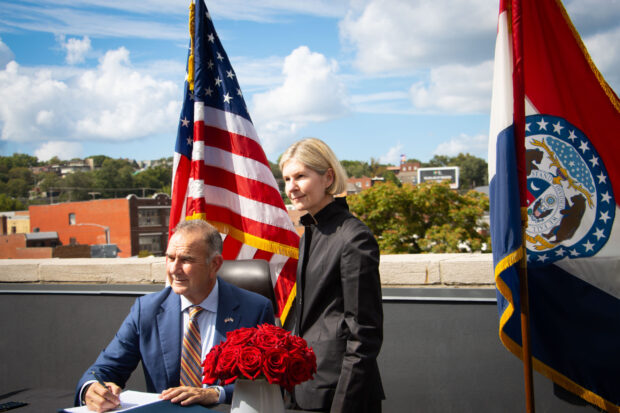
Missouri Governor Mike Kehoe and United WE President and CEO Wendy Doyle stand together for the ceremonial signing of House Bill 2974. Photo credit: Will Crow.
Posted September 14, 2026
Missouri Governor Mike Kehoe joined United WE in signing a new bill that helps out-of-state licensed professionals get work faster in Missouri.
Governor Kehoe signed House Bill 2974, which shortens the wait time for qualified professionals licensed in other states to begin working in Missouri. The bill was formally signed into law on July 13 and is effective August 28. Rep. Melanie Stinnett of Springfield sponsored HB 2974, and Sen. Jamie Burger of Benton handled it in the Senate.
Under the new law, a telehealth care provider licensed by another jurisdiction—and licensed in Missouri with a waiver of examination, education, or experience requirements—can practice in Missouri.
Additionally, HB 2974 adds physician assistants, athletic trainers and dietitians to Missouri’s health care licensing compacts. The addition of these professions now brings the total number of compacts Missouri has joined from nine to twelve.
Missouri House Speaker Dr. Jon Patterson and Rep. Sherri Gallick also attended and spoke at the event, which was held on the rooftop of the United We headquarters in the Crossroads District.
“Reciprocity is just a common-sense piece, especially when it comes to healthcare, so we can recognise licensure from other states and therefore, especially with Missouri having eight states around us, it really makes a big difference for some of our healthcare professionals to not go through the cumbersome needs that are sometimes required. We want them to be safe, we want them to be professional, we want them to be licensed and educated, but we don’t want bureaucratic paperwork to get in their way; that’s what this bill does,” Kehoe said.
United WE President and CEO Wendy Doyle supports the bill, stating that licensing barriers can keep skilled people — especially women — from entering, reentering, or advancing in the workforce.
Particularly in rural parts of Missouri, health care licensing has suffered due to less access to resources, support and professionals.
“What we like about this bill is the ability to perhaps bring somebody from across the state line to provide support in our rural communities — like in the Bootheel, there is the ability to bring someone from Oklahoma over who could provide some health care support. Our rural communities are suffering tremendously. This is one step toward a solution for our rural support,” Doyle said.
The United We is currently working on a national research study on occupational licensing that will be completed in Q1 of 2027, according to Doyal. The study will conduct a deeper analysis of Missouri, Kansas, and a couple of other surrounding states.