
HOME | ABOUT US | MEDIA KIT | CONTACT US | INQUIRE
HOME | ABOUT US | MEDIA KIT | CONTACT US | INQUIRE
Can Jackson County Hit Pause on the AI Boom—Without Losing It?

PUBLISHED APRIL 2026
There is a moment in every economic cycle when momentum becomes its own argument.
For Kansas City, that moment has arrived not with a ribbon-cutting or a hiring surge, but with a different metric altogether: megawatts. The region’s emergence as a magnet for hyperscale data centers—projects measured less in headcount than in electrical load—has created a development wave unlike anything local governments have had to manage before.
And now, in Jackson County, officials are asking a question that would have seemed unthinkable even a year ago: Should we slow this down?
The county’s call for a 120-day development moratorium—temporary, targeted, and framed as a chance to study impacts—lands at a delicate moment. The pipeline of projects across the Kansas City region is not just active; it is surging, with proposed developments that collectively rival major generation assets in their energy demands.
That context matters. Kansas City is no longer recruiting projects that use electricity—it is recruiting projects that, in aggregate, begin to resemble entire segments of the grid itself.
Sean Smith, the legislative vice chair sponsoring the ordinance, has framed the moratorium less as resistance and more as timing. His public statements following introduction of the measure have centered on public concern—concern that found expression in April’s municipal elections in Independence, where opposition to a large-scale data center proposal helped unseat two City Council incumbents who had supported incentives for the project.
The Jackson County moratorium, Smith says, “gives us time to just be thoughtful when we don’t have an application pending.” That timing, he argues, is deliberate: no active applications, no immediate political pressure, and therefore a window to write rules before the next wave arrives.
“It’s just logical and rational to try to identify what those concerns are and build them in as rules,” Smith said. “So when people apply, they know what is acceptable.”
The proposal itself—120 days—would temporarily halt new land-use applications for data centers and battery storage systems while the county rewrites its development code.
And critically, Smith has been explicit about what this is not: “It’s a good time to have just some thoughtful discourse and make sure we get it right.”
That framing matters. The ordinance cites the “rapid emergence and expansion” of data centers and flags concerns tied to land use, infrastructure strain and public safety.
In other words: the pause is a response to speed.
Against that backdrop, a moratorium is not simply a zoning decision. It is a signal—and signals, in economic development, travel fast. Public comments tied to the Jackson County measure have centered on familiar themes: infrastructure strain, land-use compatibility, environmental considerations, and—most critically—the long-term cost implications for existing residents and businesses.
Those concerns echo the underlying tension already shaping the region’s data-center debate: Can the grid expand quickly enough? Can costs truly be contained? And who bears the risk if projections fall short?
For utilities, the answer has been consistent: growth can be managed.
Executives with Evergy have repeatedly emphasized that large-load customers are being brought onto the system under tariff structures designed specifically to shield existing ratepayers—premium demand pricing, minimum-load commitments, and long-term contractual obligations intended to ensure that hyperscale users pay not just for their own infrastructure, but for the incremental cost of serving them.
In public remarks and investor communications, Evergy leadership has gone further, arguing that those customers can ultimately help stabilize rates by spreading fixed costs across a broader base.
Municipal utilities, however, are navigating a different reality.
At the Kansas City Board of Public Utilities, where total system peak hovers around 500 megawatts, officials have acknowledged that even a handful of large data-center projects could require a step-change in infrastructure—moving beyond incremental upgrades into high-voltage transmission expansion.
In Independence, where a single proposed campus could exceed existing system capacity several times over, Independence Power & Light has explored models that would tie new generation directly to the project, isolating costs as much as possible from existing customers.
Across all three utilities, the message has been broadly aligned: the power can be delivered. The unresolved question is how the costs of delivering it are ultimately distributed.
Local governments, meanwhile, operate on a different time horizon—and with a different set of exposures. A county is not just thinking about megawatts. It is thinking about roads, water, tax base composition, land absorption, and the political optics of approving projects that consume enormous resources while generating relatively modest employment.
That mismatch—between scale of investment and scale of visible community impact—is driving much of the hesitation.
If the concerns are understandable, so is the risk. Data-center developers are not tethered to a single jurisdiction. They are site selectors operating across a wide geography, balancing power availability, land cost, regulatory certainty and speed to market.
Kansas City’s competitive advantage has been precisely that: a multi-county, bi-state ecosystem where projects can move quickly, often with coordinated support from utilities, municipalities and economic-development agencies.
That raises the central strategic question: If one county taps the brakes, does the market slow down—or simply move next door? The Kansas City metro’s structure complicates the answer.
Spanning 16 counties across Missouri and Kansas, the region is less a single market than a network of overlapping jurisdictions, each with its own development posture. A pause in Jackson County does not halt regional momentum; it redistributes it. Wyandotte, Platte, Clay and Johnson counties all remain in play—many with active proposals and, in some cases, aggressive recruitment strategies.
That fragmentation can be an asset, allowing the region to absorb demand across multiple nodes. But it also introduces competitive tension.
If Jackson County is perceived—even temporarily—as a more complex or uncertain approval environment, developers may simply bypass it. And once large-scale infrastructure decisions are made elsewhere, they are not easily reversed.
The moratorium does not exist in a vacuum. It follows one of the largest—and most contentious—economic-development decisions in the region’s history: the approval of a massive AI campus in Independence tied to Nebius. That project, described as a potential $150 billion long-term investment, has already triggered legal challenges, citizen petitions and debate over tax incentives and transparency. It’s also been cited as a factor in this month’s election defeats of two incumbent City Council members who had voted to approve incentives for the project.
For county legislators, the Independence example became a case study in what happens when projects outpace policy. Smith has pointed directly to local impacts—including land-use conflicts—as justification for tighter rules: “You’re going to take farmland…and turn it into something very different.”
He has also raised process concerns, including notification standards for nearby residents, signaling that the issue is not just scale, but how decisions are communicated and absorbed politically.
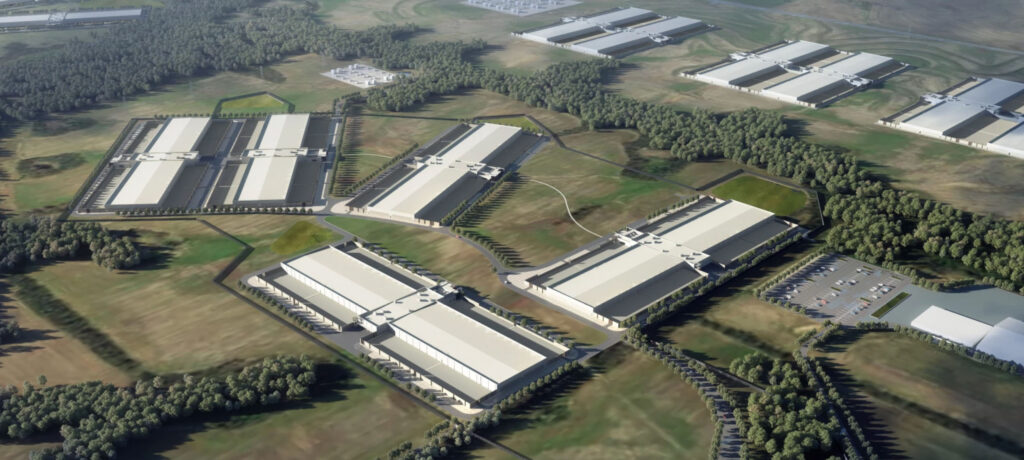
Diode Ventures’ rendering of Golden Plains Technology Park, a 882-acre, 750-megawatt hyperscale data center hub straddling Clay and Platte counties. It’s been a major game-changer for the region’s reputation as a development site for such projects.
From a developer’s perspective, the calculus is straightforward. Hyperscale projects require certainty on timelines, predictability on costs and confidence in infrastructure. A moratorium, even one framed as a short-term study, introduces uncertainty into all three.
That does not automatically make a jurisdiction unfriendly. In many cases, developers expect periodic recalibration in emerging markets. But duration and clarity matter.
A tightly defined pause with a clear end date and articulated objectives can signal discipline. An open-ended halt risks being interpreted as hesitation at precisely the moment competitors are accelerating.
Utilities, meanwhile, are attempting to hold the center. Evergy’s position—that large-load customers can be integrated without shifting costs to existing ratepayers—rests on structural protections that are increasingly common in high-growth markets.
Still, even utility executives acknowledge, in broader industry discussions, that perfect insulation is difficult to guarantee. Large-load customers require not only direct interconnection infrastructure, but also system-wide investments: additional generation capacity, expanded transmission networks and higher reserve margins to maintain reliability.
Those are costs that, over time, become embedded in the broader system.
Municipal providers face that reality more immediately. For them, the question is not theoretical—it is operational. How quickly can infrastructure be built? How much risk can be isolated? And what happens if demand projections shift?
A county-level pause does not answer those questions. It may, however, create space to ask them more deliberately.
There are, broadly, two ways this moment can misfire: moving too fast, or moving too slowly. Move too fast, and infrastructure is built for demand that arrives more slowly—or not at all. Costs are incurred upfront; revenues lag. The result is stranded investment, with pressure diffusing into the broader rate base. Move too slow, and projects migrate to more responsive jurisdictions. The region’s share of the data-center economy consolidates elsewhere, along with the associated tax base and infrastructure investment.
The challenge for Jackson County is not choosing between growth and caution. It is sequencing them correctly.
Not all pauses, however, are equal. A well-defined moratorium can signal discipline. A poorly defined one can signal uncertainty. The distinction will be shaped by duration, scope and outcome.
The Kansas City area’s position in the national data-center landscape is still emerging.
Markets like Northern Virginia and Texas have already absorbed years of hyperscale growth—and the valuable lessons that come with it. Those lessons include not just economic upside, but also rising scrutiny over land use, power consumption and long-term rate impacts.
Kansas City is encountering those questions earlier in its growth curve—both an advantage and a burden.
It allows local governments to learn from other markets. It also forces them to make high-stakes decisions with incomplete information.
Smith’s public comments—and the moratorium-ordinance language itself—underscore something subtle but important: this is not a rejection of data centers. It is a recognition that the region may be moving faster than its policy framework.
That distinction will matter to developers, because while a moratorium introduces friction, the rationale behind it—predictability—can ultimately reduce risk if it produces clear rules. The question is whether the market waits for that clarity.
Ultimately, the fate of data-center development in Kansas City will not be decided by any single county. It will be determined by how the region, collectively, balances speed with scrutiny, incentives with infrastructure, and opportunity with risk.
Jackson County’s move introduces a new variable into that equation. It may slow activity within its borders. It may redirect investment elsewhere. Or it may, if executed with precision, produce a framework that other jurisdictions may adopt.
For decades, economic development in the region revolved around a familiar question: How many jobs will this project create? That question no longer captures the stakes. The more relevant one now is this: How much of the future grid are we willing to build—and on what terms?
Jackson County’s answer, at least for the moment, is that it wants a closer look before proceeding. In a market defined by acceleration, that is a notable shift.
Whether it proves to be a strategic pause or a competitive misstep will depend on what comes next—and how quickly the rest of the region moves in the meantime.