
HOME | ABOUT US | MEDIA KIT | CONTACT US | INQUIRE
HOME | ABOUT US | MEDIA KIT | CONTACT US | INQUIRE
A complex system pivots to laser in on work-force development and the ROI.
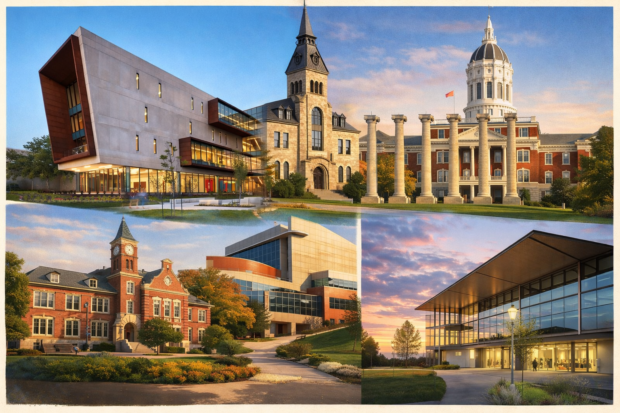
ChatGPT Generated Image
PUBLISHED FEBRUARY 2026
The numbers arrive each winter with the cool detachment of a market report. But for university presidents and provosts across Missouri and Kansas, they read like marching orders.
The Winter 2026 salary projections from the National Association of Colleges and Employers show computer-science graduates commanding projected average starting salaries above $81,000 at the bachelor’s level, engineering close behind, and business degrees rising at a healthy clip. At the master’s level, the projected increases are even more striking—double-digit growth for computer science and MBA graduates.
In Columbia, Lawrence, Manhattan and Kansas City, those figures are not abstractions. They are shaping curricula, catalyzing partnerships and accelerating decisions about what to grow, what to redesign and, in some cases, what to let go.
Higher education in the bi-state region is not in revolution. But it is in recalibration—toward workforce alignment, affordability, and demonstrable return on investment.
AI as a Bellwether
Few developments illustrate that shift more clearly than the University of Missouri System’s recent approval of new graduate degrees in artificial intelligence at both the flagship Columbia campus and the University of Missouri–Kansas City.
At UMKC, Chancellor Mauli Agrawal framed the move as strategic positioning, saying the programs will equip graduates with skills employers increasingly demand and allow them to harness AI’s “powerful potential” across industries. The message was unmistakable: this is not academic curiosity; it is labor-market necessity.
The AI programs sit within a broader pattern at UMKC. The university has leaned heavily into health sciences, computing and business fields aligned with regional employer needs. Its expansion of the RooMentum Pathways initiative, including partnerships with the Kansas City Kansas Community College, is designed to smooth transfer routes into high-demand majors.
Assistant Vice Provost Doug Swink described the goal as preparing graduates to contribute immediately to the Kansas City economy. Embedded in that phrasing is the evolving expectation placed on four-year institutions: that graduates arrive not only educated, but deployable.
UMKC’s trajectory reflects a larger urban public strategy—pairing flagship-level research ambitions with deeply regional workforce commitments.
The Health Work Force
If AI is one frontier, health care is another—particularly in a region grappling with provider shortages.
At Kansas City University, leaders have not been shy about aligning mission with workforce. The creation of its College of Health Professions and new graduate path-ways such as a Master of Health Science in Anesthesiologist Assistant, were explicitly framed as responses to regional, national shortages.
University statements emphasized expanding opportunity while addressing critical care gaps. KCU has also launched a Rural Health Scholars program aimed at accelerating students into medical and dental careers serving underserved communities.
In a moment when families increasingly scrutinize the earning power of degrees, KCU’s strategy positions health professions as both mission-driven and economically rational. Physician and advanced practice pipelines offer some of the strongest salary and employment projections nationally. KCU’s expansion signals confidence that demand will hold.
More subtly, it also reflects a private institution’s need to anchor enrollment in high-return fields that justify tuition investment.
The Flagships: KU, K-State and Mizzou
At the University of Kansas, engineering, computing and health disciplines have been prioritized within strategic plans that emphasize research growth and economic impact. KU leaders have consistently described the university as an innovation engine for Kansas, linking degree production in STEM fields to workforce competitiveness.
The emphasis is not purely rhetorical. Investments in cybersecurity, data science and health-related programs reflect alignment with employer demand curves highlighted by national salary surveys. Graduate program expansion, particularly in online formats, also addresses the growing market of working professionals seeking credentials tied directly to advancement.
At Kansas State University, the applied dimension is especially visible. K-State’s polytechnic campus and aviation programming in Salina respond directly to aerospace industry demand. University leaders frequently frame their mission around producing graduates ready for advanced manufacturing, agriculture technology and engineering roles central to Kansas’ economy.
Meanwhile, at the University of Missouri—Mizzou—the AI initiative is only one signal among many. Engineering growth, health-sciences expansion and industry partnerships increasingly dominate administrative messaging. University leaders have spoken about preparing graduates for “future-facing” careers, language that echoes employer surveys and workforce forecasts.
Across all three flagship institutions, one theme recurs: research excellence must intersect with employability. The old dichotomy between intellectual inquiry and career preparation is narrowing.
Community Colleges
If research universities are recalibrating, community colleges are often moving fastest.
The Johnson County Community College has expanded programs in cybersecurity, nursing and technical trades, building curricula in close consultation with employers. Its value proposition—lower tuition, direct workforce entry, and strong transfer pathways—resonates strongly in a region sensitive to cost.
Similarly, Metropolitan Community College has leaned into logistics, IT support and health-care credentials that can be earned quickly and stacked into higher degrees.
State-level transfer reforms in Missouri have reinforced this ecosystem, simplifying pathways from associate to bachelor’s degrees. The message is practical: start affordably, move efficiently, graduate employable.
For four-year institutions like UMKC, partnerships with community colleges are no longer peripheral—they are enrollment and workforce strategy.
Academic Reorganization as Strategy
Workforce alignment is not only about adding programs. It is also about restructuring institutions internally.
At Northwest Missouri State University, former Provost Jamie Hooyman described a sweeping academic reorganization as necessary amid “changing student expectations, rapid advances in technology, enrollment pressures, funding challenges and evolving workforce demands.”
The phrasing captures the convergence of forces reshaping higher education. Demographics are flattening. Technology is accelerating skill cycles. Employers are explicit about needs. Families are increasingly skeptical about cost.
Reorganization, in that light, becomes a survival tactic and a positioning strategy.
The NACE projections provide reassurance to leaders willing to pivot toward STEM and business growth. Computer occupations and physical sciences show some of the strongest projected increases. Business administration and marketing are climbing. Engineering remains robust.
But the data also contain cautionary notes. Social sciences salaries show a slight dip at the bachelor’s level. Doctoral-level projections in computer science and engineering reflect modest declines year over year.
The takeaway is not abandonment of the liberal arts—not a wholesale abandonment, anyway. Rather, institutions are reframing those curricula—integrating communication, ethics and critical thinking into technically oriented majors, or packaging them alongside career-focused minors and certificates.
In boardrooms, the conversation increasingly centers on portfolio balance: ensuring intellectual breadth while safeguarding enrollment and financial sustainability.
Affordability and Acceleration
Another pattern is emerging alongside program realignment: acceleration.
Three-year degree pathways, expanded online delivery, credit for prior learning and embedded internships are proliferating. The objective is twofold: reduce time to degree and enhance immediate employability.
Wichita State University has built national attention around its applied-learning model, integrating paid internships directly into academic programs. Students earn while they learn, mitigating debt while gaining experience.
At UMKC, experiential learning has become central to messaging. At KCU, clinical integration is inherent. Across the region, presidents increasingly describe internships, industry projects and applied research not as supplements, but as core components of value.
A Regional Identity Shift
The Missouri-Kansas higher education corridor has long been defined by a mix of flagship research institutions, faith-based liberal arts colleges, and a dense network of community colleges. That diversity remains. But organizing principle behind it is evolving.
Where institutions once competed primarily on prestige, campus amenities or tradition, they now compete on outcomes—placement rates, starting salaries, employer partnerships.
This shift is not purely reactive. It reflects a broader economic transformation in the Midwest. Advanced manufacturing, logistics, agriculture technology, health care and financial services dominate regional employment growth. Universities are responding by aligning degree production accordingly.
At UMKC, growth in AI courses and health sciences signals confidence in Kansas City’s tech and medical economy. At KCU, expansion underscores belief in sustained health-care demand. At KU and K-State, research investments mirror statewide workforce priorities. At Mizzou, interdisciplinary technology initiatives suggest an ambition to remain central to Missouri’s innovation ecosystem.
The Tension Ahead
Yet this recalibration is not without tension. How far should universities lean into labor-market alignment without compromising academic diversity? How quickly should they sunset low-enrollment programs? Can they balance research ambition with undergraduate affordability?
Presidents tread carefully in public remarks, emphasizing mission continuity even as programming shifts.
Still, the direction is clear.
Higher education in Missouri and Kansas is moving toward a model defined by:
Not Abandonment, but Adaptation
The transformation underway is not a repudiation of higher ed’s historic ideals. It is, rather, an adaptation to new expectations.
Families want evidence that tuition yields earnings power. Employers want graduates who can contribute immediately. Legislators want workforce alignment and economic return. Students want flexibility, speed and mobility.
In response, the region’s institutions are adjusting portfolios, reorganizing colleges, launching AI degrees, expanding health professions, deepening transfer pathways
and embedding applied learning.
The NACE salary projections are only one data point. But they crystallize the economic logic behind decisions already underway.
In Columbia, Lawrence, Manhattan and Kansas City, the future of higher education is being written not only in mission statements, but in program approvals, partnership agreements and board agendas.
It is a quieter transformation than a revolution. But it is no less consequential.
And in Missouri and Kansas, it is happening now.