
HOME | ABOUT US | MEDIA KIT | CONTACT US | INQUIRE
HOME | ABOUT US | MEDIA KIT | CONTACT US | INQUIRE
CENTRALITY Powers Kansas Business and Enriches Life.
It sits on private land, so you can’t just go there, but less than a mile away, near the tiny burg of Lebanon, Kan. (population: 181), is a small monument that holds much bigger significance for the Kansas economy. It’s the Geographic Center of the Lower 48 States. It was determined not by odometer, but by finding the “center of gravity” for the contiguous United States—the point at which a map of the nation would balance if it were of uniform thickness.
For the cartographers and orienteers, the precise technical spot is N 39° 50’ 00” W 98° 35’ 00”.
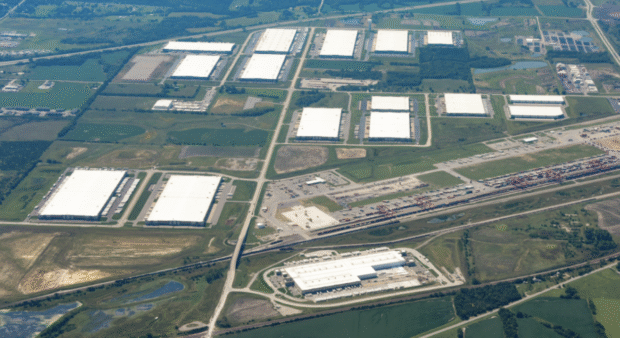
The marker attests to attributes that make Kansas a unique and unparalleled site for any company seeking to distribute its products across the nation. The Sunflower State could just as easily claim marketing rights as The Logistics Capital of America.
But there’s much more to that centrality than a competitive advantage in distribution networks. Ask 10 Kansans to define the perfect Sunflower State lifestyle, and you’ll likely get 10 different answers. That’s because Kansas isn’t a monolith; it’s a dynamic tapestry of living options. From the vibrant hum of a metropolitan center to the quiet charm of a Main Street, from the cutting-edge research on a university campus to the enduring values of a family farm, Kansas offers a singular advantage: choice.
This diversity is more than just a point of pride—it’s the direct result of the state’s strategic centrality, a quality that fuels business growth and, in turn, cultivates an unparalleled quality of life for its residents.
At the heart of this success is the powerful economic engine of Johnson County, abutting the state line with Kansas City, Mo. Consistently ranked among the nation’s top counties for per capita income and educational attainment, its substantial buying power has created an economic force that is difficult to overstate. In the past decade alone, four major retail centers, each exceeding $300 million, have opened to serve this thriving community of over 625,000. The growth is strategic and intelligent, particularly along the K-10 “Smart Corridor” connecting to Lawrence, home to a major research institution, the University of Kansas. This nexus is purpose-built to attract bioscience and life science industries, proving that the state’s appeal extends far beyond traditional commerce.
The narrative of growth, however, is not confined to a single county. Witness the remarkable transformation of Wyandotte County, where a generation of visionary investment has rewritten its story as Johnson County’s northern neighbor. The catalyst was the Kansas Speedway, a premier destination strategically located near the interchange of I-70 and I-435. Since 2001, it has drawn hundreds of thousands of visitors, serving as the anchor for the sprawling Village West retail and entertainment district. This public-private triumph, now evolving with an $80 million global soccer village, positions Kansas at the center of the world stage with the metro area’s designation as a host city for the 2026 FIFA World Cup.
This central advantage ripples across the state, empowering communities of all sizes. Lawrence has blossomed from a quintessential college town into a cultural and commercial hub, its identity enriched by world-class museums, performing-arts venues, and artistic energy. To the south, Wichita’s storied entrepreneurial spirit, born from the aviation industry, offers a robust urban experience without the crippling congestion of coastal metros. Its thriving retail corridors, like Rock Road and Maize Road, pulse with activity, serving as community spines that connect neighborhoods to commerce and entertainment.
Even the state’s governmental heart, Topeka, leverages its central location. Residents enjoy the benefits of a capital city with a robust arts scene—from Downtown galleries to the Topeka Performing Arts Center—while being just an hour from Kansas City and minutes from Lawrence. This accessibility is a hallmark of the Kansas lifestyle.
Furthermore, the presence of Regents universities in cities like Manhattan, Pittsburg, Emporia, Hays, and Salina creates oases of opportunity. These institutions provide not just artistic and retail amenities envied by similar-sized towns, but also stable, higher-paying jobs. This economic stability, combined with a low cost of living and a remarkable sense of community, creates the population stability that eludes much of rural America.
In Kansas, centrality isn’t just a point on a map. It’s the core of a business-friendly environment and the foundation for a rich, stable, and fulfilling life. The state’s prime position fuels economic vitality that directly translates into vibrant, diverse, and prosperous communities where people and businesses don’t just succeed—they thrive.