
HOME | ABOUT US | MEDIA KIT | CONTACT US | INQUIRE
HOME | ABOUT US | MEDIA KIT | CONTACT US | INQUIRE
How affordability fuels business and residents alike, building better bottom lines and high-quality lifestyles.
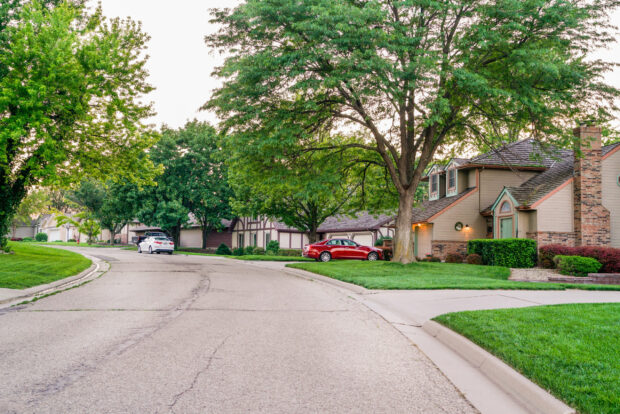
In the relentless calculus of corporate site selection and talent strategy, the metrics of success are often complex. But in the heartland, the equation is refreshingly simple. For businesses operating in Kansas, two powerful, interconnected cost considerations are creating a competitive edge that is as straightforward as it is potent: a lower cost of labor driven by a significantly lower cost of living, resulting in a workforce that enjoys a higher standard of living.
This is the Sunflower State’s open secret. While coastal hubs grapple with soaring expenses that erode take-home pay, Kansas offers a compelling value proposition for employer and employee. The state’s affordability isn’t a perk; it’s a strategic economic engine.
The Foundation
It starts with a housing market that defies national gravity. Home values across the nation have soared after the pandemic, and Kansans were not immune to that trend. Owners, of course, benefited handsomely; buyers continue to feel the sting.
Yet by comparison, Kansas remains an oasis of affordability. According to the most recent U.S. Census data, the estimated median value of an owner-occupied home in Kansas currently stands at approximately $227,854—a staggering 45.6 percent lower than the national median of $419,200.
This isn’t a matter of a few undervalued properties; it’s a systemic advantage. The National Association of Realtors consistently ranks metropolitan areas like Wichita and Kansas City well down the list of the nation’s 150 largest cities in terms of actual sale prices. The median home value in Sedgwick County, home to the biggest city in the state (Wichita), was $238,682. Topeka, the state capital, is in Shawnee County, which boasts a median of just $219,824. The outlier is suburban Johnson County in the KC area; the state’s wealthiest county had a median price of $434,942.
The dynamic across the state is a masterclass in economic geography. Proximity to major urban centers commands a premium, but the savings in exurban and rural communities are substantial. Consider the case of Franklin County and its hub, Ottawa. A mere 20-minute drive from the larger college-town vibrancy of Lawrence, it offers average home values of roughly $210,235—a fraction of the figure in neighboring Johnson County. Go further out, and the bargains become even more pronounced, with some counties seeing median home values dip below $75,000.
The trade-off is that earning potential in these deeply affordable areas can be lower, unless residents are within commuting distance of a major job center. This creates a natural, flexible ecosystem where employees balance career ambitions with lifestyle goals.
Beyond the Mortgage
This affordability—an overall score of 89.7 compared to the national figure of 100—has a ripple effect, creating a statewide advantage that extends far beyond the homestead. When dissected by the standard components of cost-of-living indices—housing, groceries, utilities, transportation, health care, and miscellaneous goods and services—the state generally out-performs the national baseline.
After housing, transportation yields the next-best savings, at 90.2 on the index, while miscellaneous goods and services score 93.9 against the national average. Even in categories where Kansas flirts with the national average, it does so modestly: transportation sits at 97.3, while health care (102.1) and utilities (100.4) are only a breadth above the baseline of 100.
A Virtuous Cycle
For a CEO or a CFO, this data translates into a powerful operational reality. The cost of labor in Kansas, often already competitive, is amplified by this low cost of living. Businesses can attract and retain talent without being forced into the relentless salary inflation seen in high-cost states. A competitive offer in Kansas goes much, much further, providing employees with disposable income that fuels local economies and contributes to overall financial wellness and stability.
This creates a virtuous cycle: a lower cost of living reduces pressure on wage demands, which boosts corporate profitability and encourages investment, which in turn creates more jobs. Employees, insulated from the financial stress that plagues their counterparts in more expensive regions, can achieve a quality of life—homeownership, savings, leisure—that is increasingly elusive elsewhere.
Again, there are exceptions. Overland Park, the largest Kansas-side suburb of Kansas City, stands out with an overall cost-of-living index 11.2 points above the national average, driven by its premium housing market. But this outlier only serves to prove the rule.
In an era of remote work and a national re-evaluation of quality of life, Kansas is no longer just a flyover state. It is a strategically undervalued asset. By leveraging a fundamentally affordable ecosystem, businesses in the Sunflower State are proving that a strong bottom line and a high quality of life for employees are not mutually exclusive goals, but rather two sides of the same coin.