
HOME | ABOUT US | MEDIA KIT | CONTACT US | INQUIRE
HOME | ABOUT US | MEDIA KIT | CONTACT US | INQUIRE
Faith, Family and the American Dream
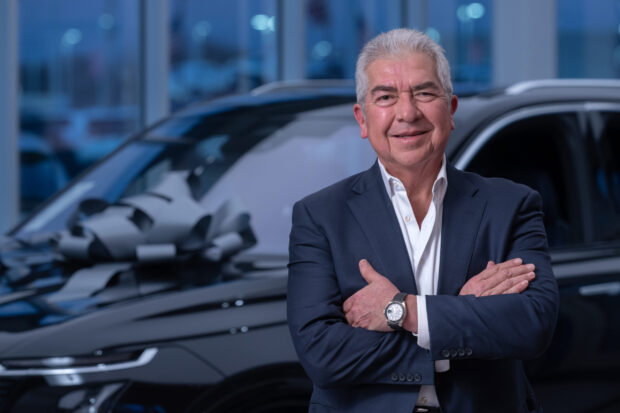
PUBLISHED JANUARY 2026
“I believe in America and I believe in what we stand for. And this (the U.S. flag) is a piece of the puzzle that has been real important to me in what we do and how we do it.”
In the high-stakes, fiercely competitive world of automotive retail, where manufacturers exert immense pressure and economic cycles can make or break fortunes, success is rarely a straight line. It is forged through resilience, an unwavering work ethic, and a clear vision.
Few executives in the Kansas City region embody this journey more completely than Carlos Ledezma, the driving force behind the expansive and growing Cable Dahmer Automotive Group.
His story is not one of inherited privilege or academic pedigree, but of a deep, abiding belief in the promise of America, instilled by parents who risked everything for it. It’s a story of starting at the absolute bottom—waking before dawn to tend horses on a remote Texas ranch at age eight—and climbing, through sheer grit and an innate understanding of business and people, to the leadership of a conglomerate comprising 32 entities, including nine car dealerships, and employing more than 1,100 people.
For him, business is not merely about moving metal. It is a calling, a platform for creating opportunity, and an expression of deeply held values centered on faith, family, and humility. As the company scales past multiple billions in revenue mark and eyes a future of 15-20 dealerships, Ledezma’s leadership offers a masterclass in entrepreneurial spirit, strategic growth, and principled management.
His work across four decades to build one of the biggest private enterprises in the Kansas City region has made him Ingram’s choice for Executive of the Year in 2026.
Carlos Ledezma’s origin story is the bedrock of his character. He was born in Kerrville, Texas, the youngest of six children and the only one born in the United States. His parents were from Mexico, and their journey to America was one of relentless determination. “My dad was caught and sent back seven times trying to get into the United States,” Ledezma recounts, a fact he delivers not with bitterness, but with reverence for the sacrifice. “The importance of that is that he believed in America, believed in what it could do for the family.”
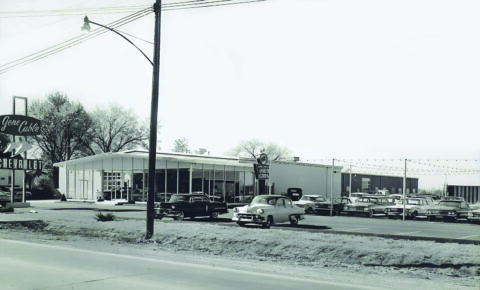
HUMBLE START: The original Gene Cable dealership.
That belief was his father’s compass. With only a first-grade education but, as Ledezma describes it, “a Harvard degree in work ethic,” his father taught the children how to work. That lesson was absorbed early and completely. At just eight years old, Ledezma was working on a small ranch in the middle of nowhere, caring for horses, guiding riders, and waking at 3 a.m. to serve hunters. “Since then to now,” he says, “we have been working our behinds off.”
This immigrant narrative is not a background detail; it is the core of his business philosophy. “When you drive around the dealerships, you’ll see American flags,” he notes. “I believe in America and I believe in what we stand for. And this is a piece of the puzzle that has been real important to me in what we do and how we do it.” His patriotism is the gratitude of a son who witnessed the price of admission firsthand.
Ledezma’s entry into the car business was born of practical necessity, not passion. At 22, with a young family—“a little one on the ground and one on the way,” he recalls—he needed reliable transportation for his sales job. His own car had “reverse out on my transmission and two bald tires.” He sought a position that offered a demo vehicle, a perk for top salespeople at dealerships at the time. “So it was a great incentive for me to get after it,” he says with a chuckle.
That was 1984. What began as a pragmatic choice quickly revealed itself as a natural fit. He was good at selling cars, but more importantly, he was fascinated by the mechanics of the business itself. “The thing that I love to say is that I love the car business, but what I really love is business,” he explains. This distinction is critical. The vehicle was the product, but the enterprise—the systems, the team, the growth—was the passion.
His talent for training and process improvement soon propelled him beyond the sales floor. He began consulting, traveling across the country for about 240 days a year, helping dealerships refine their selling skills and operations. This period was his graduate education in automotive retail, exposing him to every market condition and operational challenge imaginable.
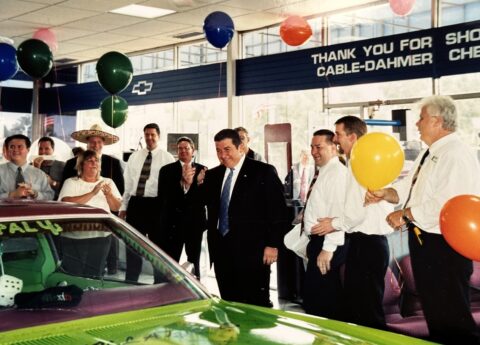
FAMILY ATMOSPHERE: Ledezma has built a high-functioning team that celebrates successes together, and those have come in bunches since he first acquired ownership of Cable-Dahmer.
The consulting path led him to Jerry Dahmer in Kansas City in 1993. For two years, Ledezma worked as a consultant for Dahmer, implementing processes and systems. Dahmer saw his value and repeatedly asked him to come on board as an employee. Ledezma refused—until he presented his own audacious vision.
“The idea that I had was, it was a vision from God,” Ledezma says. “I wanted to help somebody manage eight to 10 stores. That was my objective.” In 1991, he had theorized that managing 8-10 general managers was the optimal span of control for effective leadership. He proposed to Dahmer that they build toward that together. Dahmer agreed, with the condition that they continue refining their processes.
Finally, in 1995, Jerry Dahmer “talked me into coming to work for him as a general sales manager with the intent of being able to buy eight to 10 stores.” The goal was clear from day one: ownership and scale. Under their combined efforts, the Chevrolet store in Independence became No. 1 in the city, a feat that often placed it in the top 10-20 nationally.
The plan culminated in 2002, when Dahmer decided to sell. Ledezma bought the store for $20.5 million, a staggering figure at the time, especially as the price was largely for “blue sky” and brand value, not hard assets. “There were no assets on that number,” he recalls. Securing financing was a herculean task, involving 15 different bank rejections before General Motors’ financing arm, Motors Holding, approved what Ledezma believes remains “the highest leveraged finance package that Motors Holding has ever done in a hundred years.”
He believed he could make it work. He paid off the debt in four years.
With the first store secured, Ledezma’s strategic blueprint for growth took shape. He never wavered from his core “8 to 10” model, but refined it with a revenue target: he sought stores capable of $100 million in top-line revenue. “My theory behind it is that I think the markets contract and expand based on the economy,” he explains. Larger, high-revenue stores provide “insulation” against manufacturer pressures that often squeeze smaller dealers out.
His growth has been disciplined and fueled by deep loyalty to partners who believed in him early. General Motors and its financing successors (like Ally Bank) continued to back his acquisitions because, as he puts it, “people will finance you if they trust you and believe … you can see the same thing that we need to get done.” This trust extended to operational partners like Enterprise Rental Car, with whom he built a massive fleet leasing business that quadrupled the top line in 2024, soaring past $4 billion, and to the “lieutenants” he cultivates within the company.
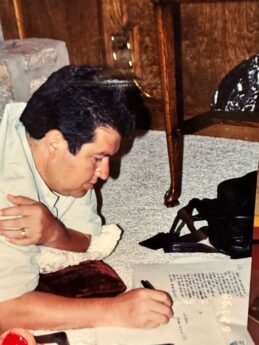
DRIVEN: Ledezma began setting detailed goals early in his career, then followed the plan to unmatched success.
Ledezma is a sole owner; he does not bring in outside financial partners. However, he actively creates pathways for operator-partners within his stores, like his 30-year partner Marty Dahmer, who recently retired. “My intent is to give them the ability to be a partner with us so that they can create some net worth for themselves.”
Now with nine dealerships following the recent acquisition of the Lawrence Kia store just last month, his vision has expanded.
“I feel like we can double in size of what we currently have right now … get to a total of 15 to 20 stores because we do have the infrastructure to handle the staff,” he says. He has also vertically integrated, bringing insurance and warranty products in-house to control quality and flexibility, and has significantly expanded commercial service operations into a renovated 20-stall facility.
For Ledezma, this scaling is not just about getting bigger. It demands constant evolution. He cites management guru Peter Drucker: “What got you here won’t get you there.” He sees AI, changing consumer expectations, and volatile policy landscapes (like federal fuel-economy standards and electric-vehicle mandates) as forces demanding daily reinvention. “If you stop changing,” he warns, “you will absolutely be muddled over by everybody else.”
If strategy is the skeleton of Ledezma’s success, his leadership philosophy is its lifeblood. It is a blend of pragmatism and profound principle, deeply influenced by his faith and his immigrant family experience.
It starts with people and with a vision: Ledezma believes the single greatest determinant of a business’s success is the vision of its leader. “Show me the vision of the person who’s leading, and I’ll show you a person that’s going to succeed. Show me a vision of a person who doesn’t have any vision whatsoever, and I’ll show you a person who has a job.” His role, as he sees it, is to help each of his 1,100-plus employees discover and chase their own vision within the company’s framework.
He rejects a one-size-fits-all approach to talent. “We’re in the people business,” he states. His gift, he says, is seeing talent in a person and then developing it based on what that person wants. “Some people want to sell cars, and they shouldn’t be selling cars. Some people are great advisers, but they should be working as a mechanic. So we got to figure out what the person wants first.” He molds the clay based on the individual’s aspirations, not a corporate template.
Faith, too, is foundational to his leadership. Perhaps the most distinctive aspect of Ledezma’s leadership is the centrality of his Christian faith. “I’m a Christian. I believe in Jesus Christ as my savior, and I really believe it’s Him that’s gotten us here, not anything else.” In 2016, he made a deliberate decision to steer the company as a Christian-based organization. They have an in-house chaplain (and are hiring a second) and a Christian-based health coach.
This is not a marketing posture, but a personal conviction about the source of his success. “I am a high-school-educated kid that came from parents from Mexico. I shouldn’t be where I’m at right now. … I do believe that this has been a calling from Him, not for me.” He is quick to admit his own flaws—“Do I screw up every day of the week?—Absolutely.” But his intent is to align his business with his values.
The final factor in his leadership equation is the primacy of humility. In an industry often marked by ego, Ledezma identifies it as the non-negotiable trait of successful leaders. He cites leadership expert John Maxwell and has internalized the lesson that “the smartest people in the room are the ones who know what they don’t know.”
He tells his staff, “My job is to be the dumbest guy in the room every day of the week. If I’m the smartest guy, I’ve got the wrong people.” This humility connects directly to his regret as the company has grown: the painful inability to personally know every employee and the details of their lives as he once did when he had the staffing of a single dealership.
At home, Ledezma is a father to two daughters and a grandfather to six. He jokes that he tries to talk them out of the family business, wanting them to find their own calling. When his grandson Chase recently mentioned going into the family business, Ledezma recalls, “I started choking on my food … ‘Oh, my gosh, don’t say that. You don’t know what the heck you’re trying to get into.’” He wants their entry to be born of love for the business, not obligation.
He remains grounded by tangible connections to his roots. He still owns “El ranchito,” the 5 acre plot with a creek in the Texas Hill Country that his father bought in 1976. He travels down three times a year—and even mows it himself. That land, he says, is a touchstone, the first property his family owned in America, a literal plot of the dream his father chased across the border seven times.
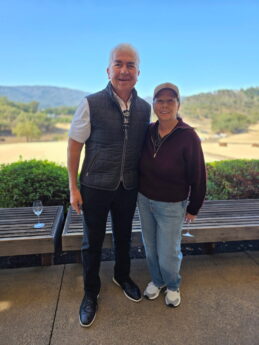
PATRIARCH: He has more than 1,000 “dependents” at work—his employees—but at home, Ledezma and his wife, Sheila, raised two daughters and have six grandchildren.
Carlos Ledezma’s career arc is a powerful narrative of the American Dream, executed with strategic precision and moral clarity. He scaled a multi-billion-dollar enterprise not by ruthless acquisition, but by building trust, empowering people, and adhering to a personal compass guided by faith and humility. From the dusty pastures of a Texas ranch to the helm of one of the region’s most formidable automotive groups, his journey underscores that the most sustainable growth is built on a foundation of purpose.
As the Cable Dahmer Automotive Group accelerates toward its next chapter of expansion, its leader remains focused on the essentials: seeing the talent in people,
filling needs in the marketplace, and reinventing constantly. The high-school-educated kid from Kerrville never forgets that his position is a gift—one he honors by ensuring his company is a vehicle not just for selling cars, but for building lives and community.
In an era that often celebrates flash over substance, Carlos Ledezma stands as a definitive example of principled, people-centered, and profoundly effective leadership.