
HOME | ABOUT US | MEDIA KIT | CONTACT US | INQUIRE
HOME | ABOUT US | MEDIA KIT | CONTACT US | INQUIRE
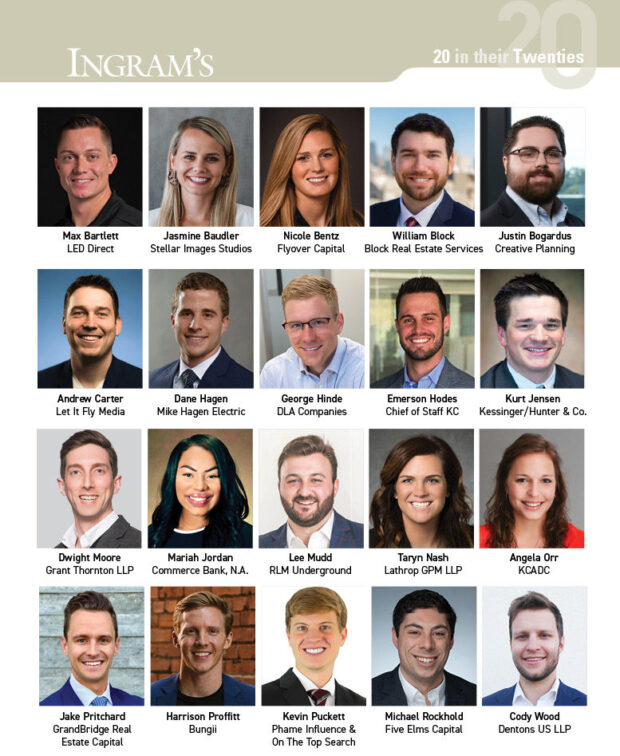
What do you get when 20 high-achieving twenty-somethings sound off on the local attributes that make Kansas City the place to work, own a business, raise a family or just kick back and enjoy life here?
Insight. And from a perspective that should get the attention of policy-makers twice the age, or more, of this year’s 20 in Their Twenties.
This year, an unseen health threat sweeping the globe interfered with our traditional assembly to introduce these talented young executives to one another; fostering cross-sector collaboration through relationship-building is something we’re big on here at Ingram’s. But we were able to get this year’s honorees’ to respond to common questions about the region’s proven strengths, its potential blind spots, and how everything here comes together to support and enhance their own career prospects and interests.
The upshot of their e-deliberations? If they had a group tattoo, it might simply read: BOBW. For Best of Both Worlds. Because time and again, they cited the Goldilocks Factor as Kansas City’s primary strength: Not too big, not too small, but just right. For lifestyle choices, for net-working, for dining and entertainment, for educational options and career-switching—in their collective mind, this is the place to be.
Can the region retain their talents for the long term? The answer is “yes, if …” What they have to say about that “if” should be of note to business execs, civic leaders and elected officials at every level.
A defining characteristic of the Millennial generation—and this group generally comprises the trailing edge of that cohort—has been a collective sense that business isn’t about personal profit; it’s about how capitalism can advance the interests of society broadly. They look for deeper meaning in their work, whether it’s a buy-one/donate one sales strategy for products, engraining volunteer service into their personal and corporate lives, or pressing for equity and an evolving national sense of social justice. Where do these young executives find that meaning?
“I constantly see other large local companies giving back and investing time into Kansas City,” says Max Bartlett of LED Direct. “I strive to be like them and not just work for a paycheck. I prefer not to chase money but instead try to pursue the successful business that’s known for participating in growth for the city.”
An important part of the mission for Jasmine Baudler’s video-production company is giving back to the community, she says, but also “to create opportunities for women in this field. We also emphasize mentorship and charity.” The more her company, Stellar Image Studios, succeeds, “the more we will be able to pay it forward.”
For William Block of Block Real Estate Services and president of Renew KC Neighborhoods, meaning is in the business plan of a charity formed to renovate, restore, and renew blighted neighborhoods. An additional goal, he said, was working “to relieve the housing crisis that exists among the homeless veteran, impoverished, and elderly population in our community.”
Creative Planning’s Justin Bogardus says “I hope that my job, and role at the firm, will result in more meaningful impact to clients and their families than just seeing their portfolio go up.” The true impact of his work, he says, is helping a client through all of life’s twists and turns—job changes, a death in the family, navigating their children going to college and, with the right guidance, becoming financially independent.
At Let It Fly Media, Andrew Carter is fixed on the value of growth that isn’t confined to a single successful company, but is an offshoot of bringing “more awareness to the great companies and entrepreneurs in Kansas City. Kansas City will always be the central hub and headquarters where we hope to continue to create jobs locally and attract the best talent to move here,” he says.
George Hinde sees the same dynamic at work with DLA Companies, which helps business owners prepare to sell their companies. Helping them increase the value of their enterprises, he says, benefits all related parties, and in the process, “we help owners leave a legacy, managers make better decisions, and employees have greater impact in their contribution to the business’s mission. When a business becomes more valuable, it is often more profitable, and can deliver more value to the market.”
“I don’t recruit and connect people to make money,” says Chief of Staff KC’s Emerson Hodes. “I’d be doing something else if I really cared about chasing a paycheck.” Instead, he wants to see the impact of helping people find jobs and helping local businesses find the talent they need to grow and operate.
At commercial realty firm Kessinger/Hunter & Co., Kurt Jensen sees an opportunity to address social ills that trace their roots to a darker side of the city’s real-estate history. Doing so will help bring wealth to neighborhoods and residents long shut out of the process. But he also says he wants “to be a resource for those people that are driven and hardworking, trying to establish generational wealth so that they can provide stable income and opportunities for their family for generations to come.”
Mariah Jordan finds a similar oppor-tunity as a recruiter for Commerce Bank. “I am passionate about helping others gain access to opportunities that allow them to grow with our organization both personally and professionally,” she says. “I am equally excited about matching talent to the lines of business I support. It’s a win-win.”
Dwight Moore promotes business growth through his consulting work at Grant Thornton, but he and his wife saw an opportunity to address burgeoning need in the pandemic era when federal assistance arrived in the mail. They used their stimulus checks to start MooreandMooreco, creating custom products like earrings and picture frames, to generate an ongoing reve-nue stream that could support charities, because “we were privileged to have our jobs and could give that money to others who were struggling more than us.”
Taryn Nash sees the generational dynamic at work within the region’s young lawyers legions. She says that they, “more than ever, are dedicated to giving back, breaking down boundaries, remedying injustices, and making KC a better place for all.”
Another of those young lawyers, Dentons’ Cory Wood, says he, too, hopes his work helps changes the lives of clients for the better. “Most of the value I create is from helping others solve problems,” he says, “I want to use my position within my organization, and within the community, to help others overcome the legal or relational barriers that hinder success.”
The Brain Drain that has plagued the Midwest for decades remains a concern, and keeping top-tier talent here has long been a thrust of business and civic initiatives.
Much has gone into remaking the city’s center, and its front door to the world—Kansas City International Airport—is in the middle of a makeover long requested by business leadership. But has the evolution of the regional economy produced the kind of sticking power needed? It’s one thing to have a Cerner Corp. in the line-up, for example, but if a tech-sector professional is looking for other opportunities, are there sufficient options right here at home? And does that dynamic play out across other key sectors?
“I believe Kansas City is well-pos-itioned to attract top talent early in their careers,” said Flyover Capital’s Nicole Bentz. “To cement our position as a top choice for talented young professionals,
I believe we need to commit to supporting our city’s entrepreneurs and early-stage companies.” That, she said, includes encouraging established corporations to engage with local entrepreneurs, leveraging them as a means to bring transparency to their industries, innovate, and drive efficiencies within their businesses. “By actively supporting our city’s young entrepreneurs,” Bentz said, “we invest in the companies that will become the major employers of our city in the future.”
Grandbridge Real Estate Capital’s Jake Pritchard concurred. “I believe the outlook for young professionals within Kansas City and the surrounding region is very positive. I strongly feel Kansas City’s market has several essential qualities, including our diversity of employment, low cost of living, and central geographic location, that have and will continue to foster a wide variety of employment opportunities.” Harrison Proffitt sees no lack of opportunities for young professionals here. “What I have noticed,” he says, “is that a lot of my friends from college, who are originally from the region, have moved to other cities for work. Again, I don’t believe this is due to enough opportun-ities here but people tend to want to ‘get outta town, and see the world,’ after school. Unfortunately, I don’t see a lot of people from other regions choosing KC as that “next city.” If we can attract more young professionals, more businesses will plant themselves here, creating even more opportunities.”
But opportunity isn’t limited to those who are seeking employers. Self-reliance, and an ecosystem that nurtures it, will play a big part in continued regional growth.
“My advice to anyone, at any stage of their career, is to take a chance,” says Lee Mudd, who did that very thing by founding RLM Underground. “Believe in yourself. It is never too late to invest in yourself, and when you do, your mentality changes. When your back is against the wall and you are 100 percent invested in your own company, you have to have a feast-or-famine mentality. Be prepared to struggle, be prepared to stress, be prepared not to give up. It pays off. It’s not everyone’s dream to become an entrepreneur, but you have to believe in yourself, 100 percent of the time.”
If they could wave a magic wand and add something to the regional mix, what would it be? “I’d really like to see a professional sports team in the T-Mobile Arena,” said Dane Hagen of Mike Hagen Electric. “The Big XII Tournament brings so much hype and commerce to the city, so being able to have those opportunities on a regular basis would be huge. But please, leave the Chiefs and Royals at the Truman Sports Complex, we love our tailgating!”
Max Bartlett called for continued growth of what he called cultural acceptance. “As a Midwest city we are still behind several others in acceptingthe differences brought to our area,” he said. “We need to progress by setting our own views and opinions aside and start focusing on what’s best of all people in our city and surrounding states.”
For Nicole Bentz, it’s “more easily available, and affordable, public trans-portation. Kansas City has a ton of unique neighborhoods but without a car, it’s not easy to get outside of your backyard.” Recent moves to extend the Downtown streetcar route is a much-needed step in the right direction, she said.
Dallas, Denver and Chicago have moved in that same direction, said William Block, and it’s paying off with a magnetism for young workers. “Accessibility is key, and I think we have the encouraging beginnings of these micro communities in areas like the Country Club Plaza, Downtown KC, and even Lenexa and Overland Park,” he said. “With new additions and local investment within the Metro such as the newly extended street car, I’m excited to see how Kansas City as a metro pivots and appeals to these next generations of the work force.”
Some challenges, though, will never be overcome, as with Michael Rockhold’s longing for ocean beaches. In the same way, Andrew Carter pines for mountains, but “not sure if Colorado is selling any, though,” he cracks. “Seriously: Kansas City is an amazing town with incredible culture, food and events. Selfishly, as someone that loves the Waldo area, there is so much potential to refresh its look
and add some fun experiential retail for family and date nights.”
If he could change anything, Justin Bogardus would alter … nothing. “I think Kansas City has a great balance (social events Downtown as well as larger events like the American Royal), while also having family-friendly act-ivities and being in a central location,” he said. “I wouldn’t want to change the atmosphere and the great balance Kansas City has between work and social/family life. I find it to be a great balance.”