
HOME | ABOUT US | MEDIA KIT | CONTACT US | INQUIRE
HOME | ABOUT US | MEDIA KIT | CONTACT US | INQUIRE
Regional executives are responding to a new urgency within higher education.
Congressional bills. Think-tank white papers. Web sites. Books. Advocacy group position papers. You don’t have to look very far in this country to understand the breadth of calls for change on America’s college campuses, especially those funded with public dollars.
To which college administrators in the Kansas City region might wryly reply: “You don’t say?”
Administrators at American universities—trying to maneuver institutions often perceived as too slow to embrace radical change that reflects the real world of the 21st century (21 percent of which is already in the history books)—are now ordering their crews to assume full speed ahead some radical transformations. The incentives for change are many. They come from business demands for better-qualified workers, parents sweating the costs of a college education, legislatures constantly under pressure to find more higher-ed dollars, even students dis-satisfied with the college experience and its value proposition.
“The world is changing around us, getting more specialized and highly educated,” declares UMKC Chancellor Mauli Agrawal. “We have real competition now as a nation.”
The pressure, he says, is building on one side with issues like computer-chip production, the focus of the recent debate in Washington over the CHIPS Act, which Agrawal says “will definitely require more post-high school education and for some jobs, a four-year degree at minimum.”
On the other side, he says, different groups in the U.S. traditionally have not been as involved in higher ed, but are starting to do that now: Groups from rural areas, under-served minorities, first-generation-to-college students. All of those will need a little extra help, since college is all new to them, to traverse it and have successful outcomes. “We need to do this in a hurry,” Agrawal says. “We don’t have time like we used to think we did.”
Much is riding on the outcome of those next moves in Missouri and Kansas.
Agrawal’s boss, MU system president Mun Choi, cited a recent report by Tripp Umbach of Kansas City, noting that the four-campus system has a $6.5 billion impact on the state economy. “At a time of declining enrollment at other universities, we’ve seen years of increases,” Choi said, noting some gathering rain clouds that could drive enrollment nationwide down further starting in 2026.
But at MU, he said, “these outcomes are results of intentional effort. Through ambitious investments in research, education and outreach—we continue connecting the work we do in labs to hands-on experiences that benefit students and improve our state.”
At the University of Kansas in Lawrence, Provost Barb Bichelmeyer shares Chancellor Doug Girod’s concerns about the need for change innovation—now.
“We know things are changing,” she says. “We need innovation and we need an educated citizenry. That is something higher ed does, but we’re not telling that story very well. We have to talk differently, yes, but some of it means we have to do things differently. We have to clarify our value proposition.”
A major change-driver, administrators say, is the conflict between the demand for a qualified work force and the time needed to produce a labor pool with those skills—which aren’t all necessarily found in technical texts.
None of the concerns from those at major research universities exempt the David Spittals of the world from challenges of their own at small, private liberal-arts colleges. Spittal, president of MidAmerica Nazarene University in Olathe, says the greatest challenges for universities everywhere can be distilled into a single word: “uncertainty.”
“The challenges of pre-COVID have accelerated and are magnified by new and complex economic, employment and regulatory issues,” Spittal says. “Rising wages and the competition for qualified or specialized personnel is increasingly challenging. The current inflationary environment is in conflict with desire to moderate or preserve affordability when cost of personnel, goods and services continue to escalate at record levels.”
While his own enterprise has been comparatively stable in recent years, “the unprecedented and complex challenges impact all institutions large, smaller, public and independent. MANU, then is “building an aggressive and innovative strategy to reposition and redesign programs, operations and financial structure focused on 2030,” he says, and the highest priority “is to be ‘student centric’ and understand and respond to the needs of a new generation and work force.”
So how are universities responding to those thorny issues?
Even at the smaller state universities, the sense of urgency is palpable, as with Missouri Western State University in St. Joseph.
“Over the past two years, MWSU has shifted our academic programs in order to focus specifically on technology-based, professional degree programs which have both high student-demand and meet the work-force needs of our region,” said President Elizabeth Kennedy. “We have collaborated with business, industry, health care, and governmental entities to create a steady supply of highly skilled and well-educated graduates in nursing, business, engineering technology, law enforcement, and education.”
MU’s Choi points to advances like NextGen Precision Health.
“Though operational for less than a year, it’s already changing lives,” he said. “For example, two NextGen faculty members recently published research that could lead to new treatments for Type 1 diabetes. NextGen is also part of a larger surge of investments in research excellence.”
Last year, he said, the university announced MizzouForward, a $1.5 billion initiative to supercharge MU’s research capacity over 10 years. It is designed, Choi said, “to change our entire research culture by bringing the right people together with the right tools to make ground-breaking discoveries faster than ever before.”
To achieve that goal, Mizzou will hire up to 150 new world-class researchers over the next five years and task them with driving new discoveries and preparing students for careers in fields that don’t even exist today. “There’s real urgency to these investments because we believe we can make a difference right now,” Choi said.
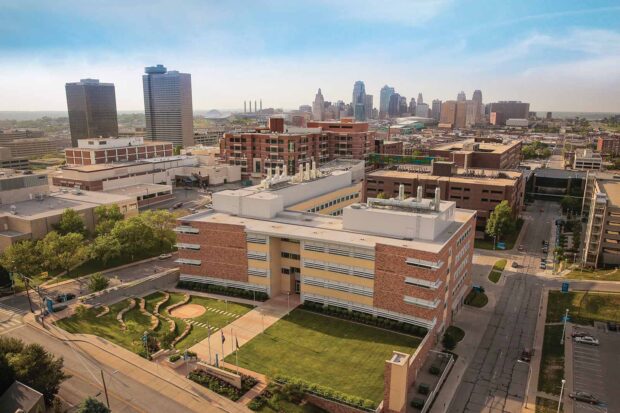
Agrawal is pleased to point out multiple efforts to transform UMKC. Among them are programs like Career Escalators, which has engaged some 75 companies and civic leaders to create instructional opportunities that accelerate internships, networking and employment preparation in high-demand fields like health care, engineering, business, education and law.
Others include physical improvements like the $100 million expansion and upgrade of the Health Sciences complex on Hospital Hill, and organizational changes, such as this summer’s restructuring outdated department silos to better align classroom instruction with skills needed after graduation.
Likening departments to Lego blocks that need to be rearranged, Agrawal asked, “Are these the correct configurations for the 21st century? They were put together and standardized in academia for couple hundred years. Does it still make sense?”
At Kansas State University in Manhattan, Richard Linton took the reins as president this past summer, and was immediately thrust into the challenge: Enrollment there is down 20 percent over the past eight years.
“This requires a whole new programmatic revamp, including better outreach, better engagement, better teachers, counselors, and prospective students,” he said. “We’re developing different means of communication to attract funding with intentional philanthropy. We have pretty robust scholarship programs that are all new in the last several months, and one of those is the tuition-free, land-grant promise, aimed at select counties, that are financial need-based. I think that is the right thing to do.”
Second on the list, he said, was addressing an aggregate $450 million bill to remedy deferred maintenance. “And that’s low compared to other institutions in the state,” Linton said. “We have a strategic plan for those buildings that can be renovated that should at some point be taken down, and also requirements for new innovative space. You have to balance between new, renovated and smart space so you can rethink and reimagine your facilities.”
For Spittal at MidAmerica Nazarene, the broad challenges will require a laser focus on strengthening the fundamentals of the college. “MNU will focus on new growth initiatives as a primary priority, debt reduction, use of technology and efficiency of operations that will produce quality programs and services and long term financial stability,” Spittal said.
Demographics are driving change, he said: “The coming significant decline in the high-school population will challenge all institutions large and small for the next 20 years. Demographic decline nationally will vary from region to region, but location near a major metropolitan area may be a benefit.”
A great concern, he said, is the dramatic change in student enrollments in social services, teacher education, ministry and other non-STEM areas of study. But he believes that “independent institutions have the greatest opportunity to be nimble and respond rapidly to the changes in market, work-force needs and trends related to student choice.”
Michelle Myers, provost at Park University, pointed out the immutable ties between campus innovations and revenue generation. “For example, the expectation would be that if we meet students’ demands for flexibility and accessibility, such initiatives would lead to increased enrollments,” she said. “Many of Park’s strategic initiatives are subjected to return on investment exercises to ensure the feasibility of the investment.”
Smaller private colleges, she said, must defend their liberal-arts mission.
“I tend to believe in the common assumption that private liberal-arts institutions with fewer than 1,000 enrolled students are in the most danger from the enrollment trends, and that many of them will close in the next decade,” Myers said. “Larger private institutions must commit to addressing the declines not by shifting investments to more professional programs, but by re-investing in the liberal arts generally (not just the social sciences, but the humanities as well). If all institutions simply chase enrollments in business, education and technology, this will be detrimental for both higher education and society generally.”
Almost in unison, these executives declare the need to be intentional in demonstrating the value of public higher education at a time when costs and outcomes are foremost on the minds of parents and students. The 17th-century French poetry degree often cited by critics of modern higher ed didn’t earn that distinction by chance. The changes to come will inevitably reshuffle the deck on degree types available.
“We need to provide programs and curriculum that will educate and train students to be successful in their careers,” Choi said. “This means that we will need to make investments in strong programs and divest from programs that no longer meet our mission. We need to focus on personal and professional development of our students through both in-classroom and experiential programs.”
Part of the challenge at K-State, Linton said, was the need to serve multiple constituencies among a span of 105 counties that range from urban to suburban and sparsely-populated farming regions.
“Take work-force development as one of those needs,” he said. “In western Kansas, that may look very different than in Kansas City or Wichita. As we try to understand how we can strengthen work force development and cater to different audiences in different part of the states, they may be 80 to 85 percent similar, but that 15-20 percent difference may include different things you don’t want to do, while others are sometimes great opportunities to move the university forward.
Down the river in Lawrence, Bichelmeyer cited five areas where KU is moving to reinforce and reposition itself with core programs essential to a major public research university, all tied to instruction and the student experience. They cover human development across the lifespan, including special education, behavioral and psychological sciences; what she calls the earth-energy-environment lines related to sustainability; molecules and medicine, to leverage the reputation of the pharmacy school, the recent National Cancer Institute designation of the KU Cancer Center’s comprehensive cancer center; safety and security, especially with cyber threats; and finally, the intersection of humanities, liberal arts and the human experience in the digital age.
All are signs that the university she joined two years ago is about to be transformed.
“I’m more excited about KU and what this means for the Kansas City region than I imagined I could be when I came here,” Bichelmeyer says, “and I was pretty excited then.”