
HOME | ABOUT US | MEDIA KIT | CONTACT US | INQUIRE
HOME | ABOUT US | MEDIA KIT | CONTACT US | INQUIRE
Into its eighth month, the COVID-19 pandemic continues to assert its presence, while businesses take additional steps to restore pre-crisis operating levels.
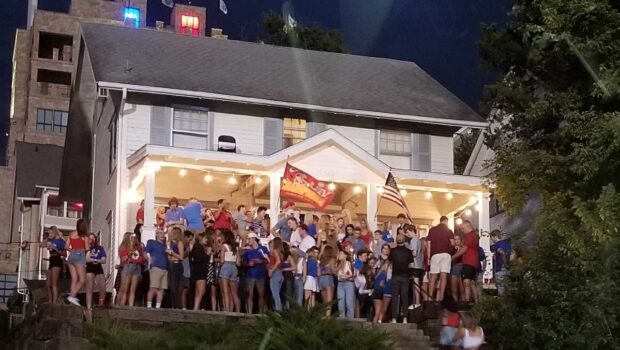
Flirting With Danger | A University of Kansas professor captured video of a back-to-school house party in Lawrence that attracted dozens of students in August, the type of mass gathering that public-health officials say is fueling the continued spread of COVID-19 in Kansas.
September 2020 is in the books, and as the nation continue wrestle with containment of the COVID-19 pandemic, it was a month of high-pro-file failures: In the final hours of the month, President Trump underwent a preliminary test that would prove positive two days later. Missouri Gov. Mike Parson and his wife both contracted the virus, though both quickly recovered. Gov. Ralph Northam of Virginia and former New Jersey Gov. Chris Christie both turned up positive. The NFL was compelled to postpone a game after an outbreak within the Tennessee Titans’ facilities, and its def-ensive player of the year turned up positive just after playing against the Chiefs in Kansas City. Broader measures of man’s inability to rein in nature weren’t hard to find.
Closer to home, increasing number of positive cases—largely a result of increased testing—produced record numbers in Missouri as the new month arrived. On Oct. 3, it surpassed 3,000 reported cases for the first time, at 3,023. It broke that threshold again 72 hours later, with 3,009. At that point, the overall case count propelled the Show-Me State to No. 18 nationally, ahead of Massachusetts and just behind Michigan. Interestingly, though, Missourians are surviving at significantly higher rates than either of those states.
Massachusetts, with a population nearly identical to Missouri’s, has seen slightly fewer cases (about 136,000 to roughly 141,500 here), but has a death rate more than four times higher: 9,538 victims to Missouri’s 2,349. Michigan, with nearly 144,000 cases, has recorded more than three times the number of fatalities, with 7,161.
Kansas, which reported no new fatalities on Tuesday, has lost 706 residents to COVID-19, and at 242 deaths per 1 million in population, ranks No. 41 among the states for that metric.
Despite the caseload numbers, a deeper look at COVID-19 metrics revealed one significant positive indicator: By the end of October’s first week, the nation had gone 14 consecutive days with fewer than 1,000 new daily reported deaths, a string not seen since the first wave of the virus bottomed out three months earlier, on July 5.
Sept. 23, with 1,116 deaths, was the most recent date to surpass that toll; in fact, it was the lone outlier in a stretch going back to Sept. 17. The decline has pushed the nation’s rolling seven-day average death count down to 719, a figure not seen since July 10.
Medical professionals and public-health authorities attribute the decline in the lethality of the virus to multiple factors: A slower spread of the virus through increased use of facial coverings by the public, continuing restrictions on large gatherings, personal hygiene practices, social distancing, heightened awareness of the risk posed to the most vulnerable groups (those older than 80 and those with existing conditions, including obesity, diabetes and lung disorders) and a better understanding of how to treat the most severe cases.
Despite that glimmer of good news, the virus itself stubbornly persists in its march across the land. But hospitals, which had feared being overwhelmed early in the pandemic, remained well-positioned to deal with an uptick in serious cases.
By month’s end, 83 hospitals in Kansas reporting to state officials that a combined 270 patients had been admitted and were being treated for COVID, occupying 5.14 percent of the state’s 5,248 beds. ICU cases accounted for 88 of that total, with about four times as many patients in ICU for causes unrelated to COVID. That left 45 percent of the state’s ICU beds still open.
In Missouri, 58 percent of available hospital beds were filled, with a higher proportion of ICU beds in use, slightly more than 66 percent.
The impact of all those metrics on business is being felt to different degrees, depending on the local jurisdiction. Kansas City, for example, has extended its state of emergency through Jan. 16, 2021. Under the terms of that emergency declaration, Mayor Quinton Lucas is authorized to order evacuations, close public thoroughfares to traffic, impose curfews, close businesses and order first-responders to report for duty as needed.
While he’s had that authority, his actions have largely been limited to issuing a requirement that people public wear face coverings, with certain exemptions, if six feet of distancing can’t be maintained. But businesses, while encouraged to keep logs of visitors, are not required to do so. Lucas also has encouraged them to adopt sick-leave policies for anyone showing signs of infection, limit use of cash, maintain a rigorous facility sanitation schedule, and provide hand-washing/sanitizing sites for employees and guests. Meanwhile, restaurants and bars are operating under reduced capacity based on distancing, and hotels have begun booking visitors again.
On the Kansas side, Gov. Laura Kelly acceded to concerns of conservatives that a repeat of lockdown orders from the spring would cause lasting damage to small businesses. She and lawmakers reached an understanding that she refrain from ordering business closures in exchange for a 30-day extension of her emergency powers to address the viral spread.
The state has posted a sector-specific series of guidelines for full reopening at covid.ks.gov, drawing on documents from the Centers for Disease Control and Prevention, the FDA, state health department, industry trade groups and other organizations. All told, they cover a dozen sectors and operations of organizations as varied as manufacturers, health-care pro-viders, religious institutions, fitness centers and pet groomers.