
HOME | ABOUT US | MEDIA KIT | CONTACT US | INQUIRE
HOME | ABOUT US | MEDIA KIT | CONTACT US | INQUIRE
The World Cup was a short-term stay in the global spotlight. What will Kansas City and Missouri actually keep once the cameras leave?
For six matches this summer, Kansas City Stadium—Arrowhead under any other name—hosted the smallest market in the FIFA World Cup’s 16-city American footprint, and pulled it off like its bigger-city rivals.
Visit KC projected roughly 650,000 visitors and $653 million in direct economic impact; independent economists have questioned those figures, and the honest answer is that Kansas City won’t know the real number until well after the final whistle. What’s not in dispute is the early read: hotel bookings up 100 percent year-over-year in the tournament’s opening days, flights from Argentina up nearly 2,000 percent—OK, it was a low baseline to start with— and short-term rental listings that grew 56 percent citywide—the fastest increase of any host market in the country.
The more interesting story than the visitor count is what the city built to earn it, and whether that infrastructure outlasts the tournament. Kansas City and its partners spent almost $200 million preparing—transit lines to the airport, stadium and fan festival, expanded policing capacity, temporary diplomatic and health-care infrastructure—money organizers are explicit about wanting to recoup, not just spend. The federal government kicked in $625 million nationally for host-city security and $100 million for transit operations, betting the exposure is worth it.
Whether Kansas City’s bet pays off the way Atlanta’s did after the 1996 Olympics, or falls short the way independent economists have found most World Cups do relative to their promises, is a genuinely open question that will take a full accounting season to answer.
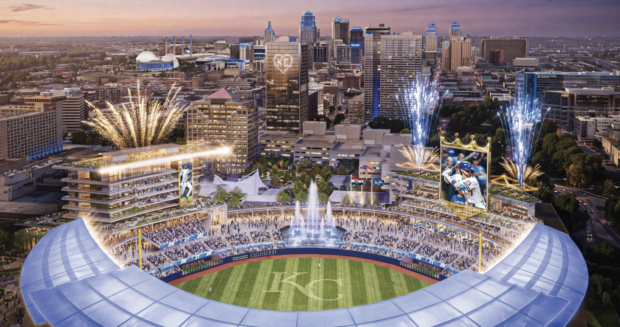
Yet that uncertainty hasn’t slowed the more permanent bets happening in parallel. In April, Kansas City advanced a $600 million bond commitment toward a proposed $1.9 billion Royals ballpark at Crown Center—using the state’s new Show Me Sports Investment Act, created in a special legislative session and now backing its first project. In July, the city committed $235 million in bonds toward a $1.4 billion expansion of the KC Current’s riverfront stadium and surrounding development, financed in part through a revived version of the Missouri Downtown Economic Stimulus Act—the same tool that originally built the Power & Light District two decades ago, now with expanded boundaries that reach the Missouri riverfront.
Both deals face real headwinds: an initiative petition could force a public vote on the Royals bond package, and at least one City Council member has acknowledged Kansas City doesn’t yet have solid data on whether these incentive tools actually pay off for the city as a whole.
That’s the honest complication sitting underneath Kansas City’s stadium moment: three major public financing commitments—Royals, Current, and the World Cup infrastructure itself—arriving in the same 18-month window, each betting that a global sporting spotlight converts into lasting economic and civic value. The city’s own finance leadership says it can’t yet prove that bet has worked before, which makes 2026’s outcome the closest thing Kansas City will get to a real-time answer.
None of this displaces the institutions that made Missouri’s cultural case long before a global tournament arrived. The Kauffman Center continues to anchor Kansas City’s performing-arts identity, as do the Nelson-Atkins and Kemper museums that remain free and world-class, and St. Louis’s Grand Center Arts District carries the same weight it always has. Those assets don’t need a World Cup to justify themselves. What they get from one, potentially, is a larger audience that discovers them for the first time this summer—assuming the visitors Visit KC is counting on, actually venture past the stadium gates and into the rest of the city they came to see.
The Chiefs, meanwhile, remain the one marquee Kansas City franchise not currently negotiating a new home—they’ve already committed to one. Kansas lawmakers approved an incentive package north of $1.8 billion to bring the NFL powerhouse across the state line, a live reminder that Missouri’s stadium-financing moment isn’t just about the Royals and Current, and that the border rivalry shaping the state’s tax policy this year runs through professional sports every bit as much as it runs through capital gains.
PUBLISHED AUGUST 2026