
HOME | ABOUT US | MEDIA KIT | CONTACT US | INQUIRE
HOME | ABOUT US | MEDIA KIT | CONTACT US | INQUIRE
Three once-in-a-generation catalysts landed on the same Missouri summer. The state’s tourism story in 2026 is what happens when they all show up at once.
It’s the final day of April, 1926. Springfield businessman John T. Woodruff sends a telegram proposing the name for a new Chicago-to-Los Angeles highway: Route 66.
One hundred years later, almost to the day, Springfield hosted the National Route 66 Centennial Kickoff—a four-day celebration with a concert hosted by Missouri State alumnus John Goodman, headlined by Little Big Town, Gretchen Wilson and Gary LeVox, drawing visitors from across all eight Route 66 states to the birthplace of the Mother Road. The Missouri Route 66 Centennial Commission has already funneled more than $1 million into community events and attractions statewide, and the celebration continues through the year—including a September motor tour retracing the original route from Springfield to Vinita, Oklahoma.
That alone would make 2026 a strong year for tourism. It isn’t alone. The same summer carries the 250th anniversary of American independence, and Kansas City spent June and July as one of 16 World Cup host cities—hosting six matches, including a Round of 32 game and a quarterfinal, with national teams from Argentina, England, the Netherlands and Algeria based in the metro for weeks at a time. Visit KC’s early numbers showed hotel bookings up 100 percent and international flight arrivals soaring in the tournament’s opening days—a visitor surge with no real precedent in the region’s tourism history, whatever the final economic accounting eventually shows.
Three catalysts, one calendar year, and each pulls a different kind of traveler: Route 66 draws the road-trip nostalgist working through a bucket list; the World Cup drew the international sports tourist who’d likely never have considered Missouri otherwise; the semiquincentennial is pulling domestic heritage travel toward historic sites across the state, from the Gateway Arch to Independence’s Truman Library. For an industry that spends most years marketing the same handful of attractions to the same regional drive market, having three genuinely new hooks arrive simultaneously is close to unprecedented.
The state’s longer-running tourism assets remain exactly what they were: the Lake of the Ozarks still carries more shoreline than California’s Pacific coast, Branson’s entertainment district keeps drawing its loyal following, and the Katy Trail’s 240 miles of rails-to-trails biking still trace the Missouri River from end to end.
What’s different in 2026 is the on-ramp. A Route 66 road-tripper working through Missouri’s stretch of the highway—Cuba, Lebanon, Springfield, Joplin—is a short detour from Lake of the Ozarks or Branson, and a World Cup visitor with a few extra days in Kansas City is a two-hour drive from either. Missouri’s tourism marketers have spent years trying to manufacture reasons for visitors to see more than one corner of the state. This year, three different reasons showed up on their own.
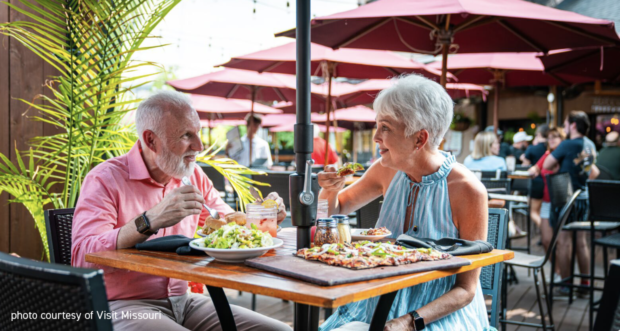
The state’s food and beverage scene gives all three catalysts a common thread worth marketing together. Missouri’s wine country, craft breweries and distilleries have spent a decade building a reputation that now has three separate audiences passing through in the same year, and the state’s barbecue and steakhouse traditions—Kansas City’s in particular—are exactly the kind of authentic, photograph-ready experience that road-trippers, sports tourists and heritage travelers all reliably seek out regardless of what brought them to the state in the first place.
There’s a fair caveat worth sitting with: big one-time events are notoriously hard to convert into repeat visitation, and Kansas City’s own World Cup organizers are already framing success less around this summer’s numbers and more around whether the city’s global exposure produces a second look from travelers, meeting planners and airlines in the years after. The Route 66 centennial carries a similar test—a birthday like this only comes once, and what the state does with the road, the signage and the story after the anniversary passes is the real measure of whether 2026 was a moment or a foundation.
PUBLISHED AUGUST 2026