
HOME | ABOUT US | MEDIA KIT | CONTACT US | INQUIRE
HOME | ABOUT US | MEDIA KIT | CONTACT US | INQUIRE
For two centuries Missouri’s transportation story ran east to west. The freight numbers moving through the state right now are quietly telling a different story.
Interstate 70 remains the visible centerpiece of Missouri’s transportation spending, and 2026 is the year the $2.8 billion Improve I-70 program stopped being a plan and became a daily reality for anyone driving between St. Louis and Kansas City. As of this spring, MoDOT had five of the program’s eight segments under contract, with more than half the 200-mile corridor now under active construction and crews completing roughly $2 million worth of work every day.
Program director Eric Kopinski has put the completed share at around 15 percent of the total corridor—modest-sounding progress that belies the scale of what’s underway: contracting, design and material procurement for a project of this size take years to front-load before pavement mileage accelerates. The Kingdom City-to-Warrenton segment, the next major piece, is expected to be awarded by November, with the full corridor still targeted for completion by the end of 2030.
That’s the update. The pivot is what’s happening alongside it. Missouri’s historic transportation identity was built on east-west connectivity—I-70 linking the coasts, rail lines feeding Chicago and the eastern seaboard. Increasingly, the freight numbers that matter run the other direction. CPKC, the only single-line railroad connecting Canada, the United States and Mexico, continues to lean into nearshoring-driven growth through its Kansas City hub—including a new partnership with Americold to co-locate cold-chain warehouse capacity at the railroad’s 180-acre International Freight Gateway, moving Mexican produce north and Midwest proteins south on the same corridor. CPKC posted a 2 percent increase in freight volumes in the first quarter of 2026 even as broader freight markets softened, evidence that the north-south network is capturing share the traditional east-west routes aren’t.
That shift is happening on the highway side too. Interstate 35, cutting thro-ugh Missouri’s northwest corner, ties Kansas City directly to both Mexico and Canada—and as automakers and manufacturers continue reshoring production closer to the U.S. market, that corridor is capturing more of the trucking traffic that once ran through more distant gateways. Interstate 49 extends the same logic south from Kansas City toward Arkansas, Louisiana and the Gulf. None of this displaces I-70’s importance; it means the state’s two great transportation axes—the historic east-west spine and the accelerating north-south one—are now both operating near capacity at the same time, which is precisely why Missouri’s infrastructure investment can’t afford to be a one-corridor conversation.
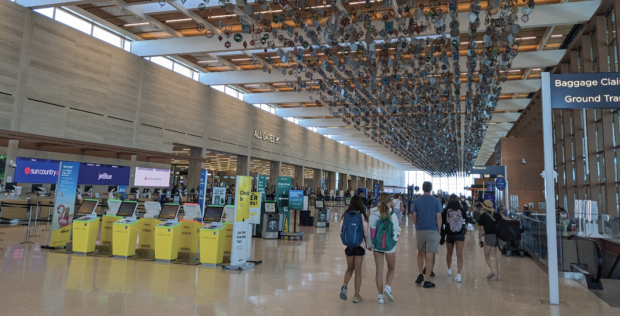
The airports are carrying their own version of that story. Kansas City International’s single-terminal replacement, three years old now, has pushed air cargo volumes well past pre-pandemic levels, while Lambert International in St. Louis has done the same—both airports now handling freight tonnage that reflects a state positioned at the center of reshored, nearshored North American trade rather than a pass-through point on a coast-to-coast route. KCI’s cargo growth is no accident: the airport now sits at the center of a 3,300-acre industrial buildout, Hunt Midwest’s KCI 29 Logistics Park, purpose-built to put warehousing and manufacturing within minutes of the runways rather than miles from them.
The human side of the I-70 build-out deserves a mention too. MoDOT has roughly 1,000 active work zones statewide on any given construction day, and the agency has leaned on temporary concrete barriers and expanded Highway Patrol enforcement to manage speeding and distracted driving through active segments—a real safety cost of a program this size, and one the state has been transparent about rather than minimizing. All Improve I-70 construction crews are Missouri-based, meaning the program is also functioning as a multi-year workforce commitment for the state’s construction and heavy-equipment trades, running in parallel with the broader labor market tightening described elsewhere in this issue.
Put together, Missouri’s 2026 transportation story isn’t really about any single project, even one as large as Improve I-70. It’s about a state whose defining transportation asset—centrality—is being tested by a genuinely new pattern of trade, and largely passing that test. The interstates, railroads and airports built for an east-west economy are proving just as valuable, arguably more so, for a north-south one nobody was fully planning around a decade ago.
PUBLISHED AUGUST 2026