
HOME | ABOUT US | MEDIA KIT | CONTACT US | INQUIRE
HOME | ABOUT US | MEDIA KIT | CONTACT US | INQUIRE
Past honorees reveal a consistent track record of identifying the executives, founders and civic leaders who would go on to shape Kansas City’s business and public landscape.
PUBLISHED APRIL 2026
If ever there were proof that Ingram’s 40 Under Forty is more than an annual exercise in optimism, the evidence is sitting in plain sight across Kansas City area boardrooms, executive suites, civic institutions and national power circles. Since the first class in 1998, the program has developed a striking record of spotting not merely bright young professionals, but people who would go on to shape industries, capital flows, public policy and the region’s broader sense of itself.
The inaugural class in 1998 and those that followed were unusually prescient in identifying future market leaders.
Start with banking and wealth management, where the alumni bench is especially deep. Kevin Barth, a member of that first 1998 class, is now chairman and CEO of Commerce Bank–Kansas City and a senior Commerce Bancshares executive with responsibility extending well beyond the home market. Jim Rine, a 2004 honoree, rose through UMB to become president of UMB Financial Corp. and president/CEO of UMB Bank. Peter Mallouk, from the 2007 class, built Creative Planning into one of the nation’s largest wealth-management firms, while Marty Bicknell, a 2005 honoree, founded and leads Mariner, another national advisory platform. Sandy Kemper, also from the inaugural class, moved from the UMB orbit into fintech entrepreneurship with C2FO, a company that has emerged as one of the region’s most consequential financial innovators.
The same pattern shows up in other sectors. Ron Lockton, recognized in 2003, rose to lead the world’s largest privately held independent insurance brokerage; Gordon Lansford, also a 2003 honoree and Ingram’s first 40 Under Forty Alumnus of the Year, became president and CEO of JE Dunn Construction, one of the country’s biggest commercial contractors. Mike Valentine turned a technology-and-health-care résumé that included Cerner into long-running leadership at Netsmart. Neal Sharma, from the 2007 class, helped build DEG from a Kansas City digital shop into a nationally known consultancy, later expanding his influence through board and civic leadership. Anne St. Peter, a 2001 honoree, turned Global Prairie into one of the country’s most prominent purpose-driven marketing firms and a standout in the B Corp movement.
And the program’s reach has never been confined to pure business. Consider Sam Graves, a 2002 honoree, who went on to become one of Missouri’s most prominent members of Congress and chairman of the House Transportation and Infrastructure Committee before announcing this year that he would not seek re-election in 2026. Jeff Roe, another 2003 alumnus, built Axiom Strategies into a nationally recognized political-consulting operation. Peter Brown went on to lead AMC Entertainment. The alumni network is populated not just by successful professionals, but by people who became institutional players.
The irony of this article, and especially the one that follows called “40 We Missed,” is that we’ll likely aggravate some remarkably achieved executives selected for this belated recognition. It might well further offend those who, for one reason or another, weren’t selected for 40 Under Forty back then, and again didn’t make the cut for this feature.
But there’s a numbers game involved here: Kansas City is shot through with high-level executive talent. Matter of fact, in 2000, a record-setting 800-plus nominations were submitted for consideration. That creates a 1 in 20 chance. Yes, we’ve offended many and maybe that trend continues with this effort. The funny thing about serving as the steward of 40 Under Forty? We’ve learned it’s not always a popularity contest.
That may be the strongest argument for the franchise after nearly three decades. Plenty of awards programs celebrate promise; far fewer can point to a lineage that includes bank chiefs, wealth-management titans, construction and insurance leaders, tech founders, civic strategists and national political figures. The true power of 40 Under Forty is not that it predicts perfection. It is that, year after year, it has shown a rare instinct for identifying who will matter most when Kansas City’s future arrives. And by now, that is no hypothesis. It is a matter of record.
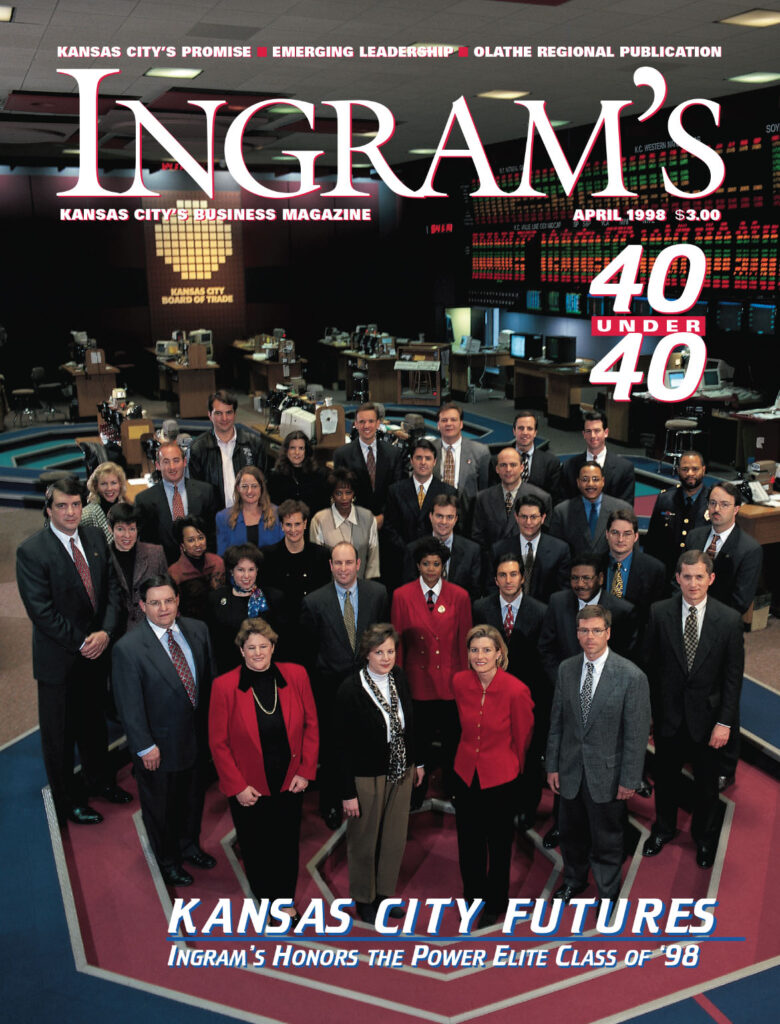
The inaugural class of Ingram’s 40 Under Forty pose in 1998 for the first cover in the trading pit of the Kansas City Board of Trade.