
HOME | ABOUT US | MEDIA KIT | CONTACT US | INQUIRE
HOME | ABOUT US | MEDIA KIT | CONTACT US | INQUIRE
PUBLISHED JANUARY 2026
“You can’t always wait for the information, so you must trust your instincts and rely on your experience to make the call.”
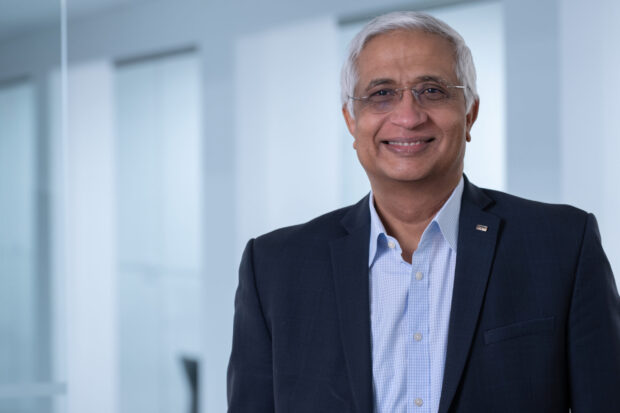
In a year when bank mergers nationwide were still largely frozen by caution and capital constraints, Ram Shankar helped pry the market back open. As chief financial officer of UMB Financial Corp., he was central to the Kansas City-based bank’s roughly $2 billion acquisition of Heartland Financial USA, the largest known transaction completed in the region in 2025. The deal did more than add assets; it signaled UMB’s readiness to compete at a new level on the national banking stage.
Shankar frames the achievement not as a bold gamble, but as the product of preparation, discipline and trust—values shaped long before the Heartland transaction emerged. “Growing up, I was surrounded by people who not only believed in me, but also challenged me to ask questions and problem solve,” he says. That emphasis on curiosity was reinforced early in his career by mentors who “coached me above and beyond the basics of a bank balance sheet or T-accounts.” Today, those lessons translate directly into his leadership philosophy: “The ability to adapt, guide and empower are intangibles that can’t be taught, but are critically important for leaders to possess.”
Those intangibles were tested when UMB announced the Heartland transaction in April 2024. At the time, bank M&A had “virtually come to a standstill,” Shankar recalls, following high-profile bank failures in 2023 and amid persistently high interest rates. Deals were being scrutinized through an unforgiving lens, with “metrics that are closely watched in merger transactions, such as tangible book value dilution and regulatory capital levels,” under intense pressure. Executing a transaction of this scale required more than ambition—it required credibility.
“We had the exciting opportunity to thaw the market with our well-structured announcement,” Shankar says. Investor confidence proved critical. UMB raised approximately $230 million in new capital, drawing support from new investors and reinforcing confidence in the bank’s strategy. Under Shankar’s leadership, the finance team worked closely with other senior executives on merger modeling, capital planning and execution. “My team, along with other executives, were intricately involved in the merger modeling and equity offering,” he says.
The complexity didn’t end there. Heartland Financial itself had recently unified 11 individual banks under a single platform, adding layers of operational and reporting challenges.
“HTLF was an amalgamation of 11 individual banks that merged under one flag just prior to our acquisition announcement,” Shankar notes. Integrating that structure required coordination across UMB’s footprint, from financial reporting to core technology systems. “Preparing for combined financial reporting and core technology systems conversion impacted many teams across the UMB footprint,” he says. “I am extremely pleased at how my team and many others completed these complex tasks.”
The transaction also accelerates UMB’s approach toward regulatory thresholds that bring heightened expectations. As banks move beyond $50 billion—and eventually near $100 billion—in assets, enhanced regulatory standards require new investments in systems, people and governance. Shankar views that evolution as a natural extension of UMB’s long-term strategy. “While challenging, such growth and the readiness for these standards is a part of our strategic plan to build scale, deepen relationships, further improve our profitability and strengthen our value proposition to all stakeholders—while maintaining our focus on risk prudence and safety and soundness.”
That balance reflects Shankar’s analytical background. Trained initially in electrical and electronics engineering before earning an MBA in finance, he approaches decision-making as both a quantitative and experiential exercise. “With my engineering background and analytical skills, I learned decision-making comes down to sizing the data set in front of you to make informed choices,” he says. “At times, you are operating with incomplete or imperfect data; you can’t always wait for the information, so you must trust your instincts and rely on your experience to make the call.”
Serving him well, he says, “is my intellectual curiosity and willingness to ask why something is the way it is. He encourages that mindset across his teams. “I want to see my team asking the tough questions.” Trust, he adds, is the foundation. “I create ownership, not just buy-in, through autonomy and delegation. This leads to shared purpose and opens the door to communication, problem-solving, and innovation as a team.”
That culture proved essential during the Heartland integration, when timelines were tight and expectations high. “During challenging times, everyone, including me, must roll up their sleeves and work together to move through any obstacle,” Shankar says. Leading by example, he believes, builds trust and prepares the next generation of leaders.