
HOME | ABOUT US | MEDIA KIT | CONTACT US | INQUIRE
HOME | ABOUT US | MEDIA KIT | CONTACT US | INQUIRE
PUBLISHED JANUARY 2026
“It’s a very tight labor market. Finding the right people, for us, is essential. It can’t just be warm bodies; they’ve got to be the best you can hire.”
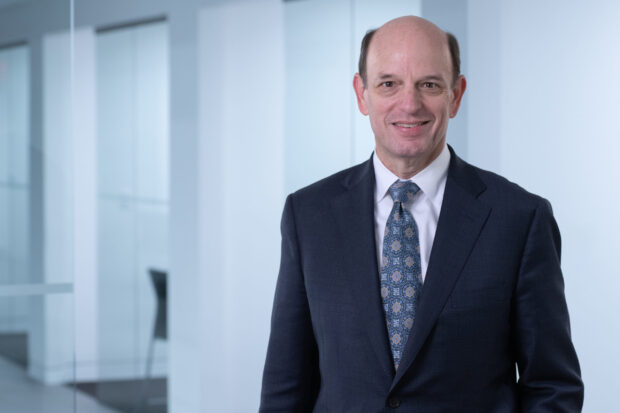
When Jeff Risinger arrived at The University of Kansas Health System in early 2023, it was already one of the region’s glittering growth stories. What followed has been something closer to a work-force transformation—one that pushed the health system past the 18,000-employee mark and into the role of Kansas City’s largest single-entity employer. For Risinger, now senior vice president and chief human resources officer, that trajectory was no surprise.
After roughly a dozen years in academic health care, he says, “you cannot be in this industry and not know the story of this health system.” From its reorganization as a public health authority in 1998 to its steady expansion of clinical research, “what happened here is a story that everyone knows—and one that if you get the opportunity, you want to be a part of.”
That reputation alone, however, wasn’t what convinced Risinger to join. Culture was—and it revealed itself quickly. “Whenever you’re in the interview process, every place talks about culture and values,” he says. “But this was the first time in my career I’d accepted the job—and what usually happens is, you start
to see the cracks in the story—but here … if anything, they undersold it.”
What Risinger encountered was an organization deeply aligned around humility, competence and authenticity. CEO Bob Page’s philosophy of “wanting a system to be led by competent but humble people,” Risinger says, is not just aspirational language. “Once you get here, and become part of the culture, you see it’s deeper and more grounded than you thought it could be.”
That culture matters profoundly at scale. Since just before Risinger’s arrival, the system has added thousands of employees—nurses, clinicians, technicians, administrators—at a pace few regional employers can match. Some came to the legacy medical center; others have been folded in as Olathe Health and Liberty Hospital were added to the organization. For Risinger, growth of that magnitude puts extraordinary pressure on onboarding, engagement and retention. His first move was to experience the process himself.
“When I got here, I sat in on the same orientation sessions everybody else starting here did—nurses, med techs, etc.,” he says. What stood out wasn’t a slide deck about values, but stories. “They didn’t get up and say, ‘this is the culture.’ They told stories about patients—how employees went the extra mile, the extra 10 miles,
to meet patient needs.”
Those stories are told repeatedly by leadership, including Kansas City President Tammy Peterman. “Tammy is a master at storytelling,” Risinger says. “She is there in every orientation, every single time—Bob and Tammy both.” Peterman’s repeated use of the phrase “our place,” he notes, is intentional. “That term has a connotation
of family … when it’s authentic, you know.”
Authenticity, Risinger believes, is the differentiator in today’s labor market—particularly in health care, where competition for talent is relentless. “It’s a very tight labor market,” he says. “Finding the right people, for us, is essential. It can’t just be warm bodies; they’ve got to be the best you can hire.”
But hiring alone isn’t enough. Risinger worries about what’s lost when employment becomes transactional, particularly in remote or hybrid environments. “For a sizable number of positions … changing jobs is essentially mailing a laptop to one company and getting another from the new one,” he says. “A lot is lost in terms of the feeling and concept of joining a new organization.”
That loss of connection, he warns, happens “very slowly and incrementally—and once lost, it is hard to regain.” His response has been a renewed emphasis on high-touch onboarding, supported by technology that removes friction. “We’ve got a concept called Day One Ready,” he says. “It allows new employees to show up that first day with all that done so they begin the cultural part—meet their team and their leader—and not focus on stacks of papers.”
The goal is emotional as much as operational. “We want people who go home on day one thinking that they made the right decision to work at this place,” Risinger says. “The phrase we hear a lot is that there are no jobs to fill here—only careers to fill.”
That message resonates across generations, he believes. “Everyone wants to be respected and valued,” he says. “What’s changed is that younger generations demand that.” And that’s a good thing: “Gen Z will make the workplace better because they expect leaders to be leaders.”
For an organization of this scale, expectations are everything. Risinger measures success not just through engagement surveys and first-year turnover, but through what he calls the “energy in the room.”
The health system aims for engagement “in the top decile,” he says—echoing Page’s mantra: “Proud, but never satisfied.”
At its core, Risinger’s philosophy is simple. “The most precious thing people have to give you is their time,” he says. “You need to treat that as though it’s as significant as anything else we’d celebrate.”