
HOME | ABOUT US | MEDIA KIT | CONTACT US | INQUIRE
HOME | ABOUT US | MEDIA KIT | CONTACT US | INQUIRE
A Time of Promise and Peril
For an institution serving roughly 1,000 teen boys, Rockhurst High School’s hallways were eerily silent on the morning of Dec. 19, as those students hunkered down in classrooms to tackle the last of their fall-semester finals.
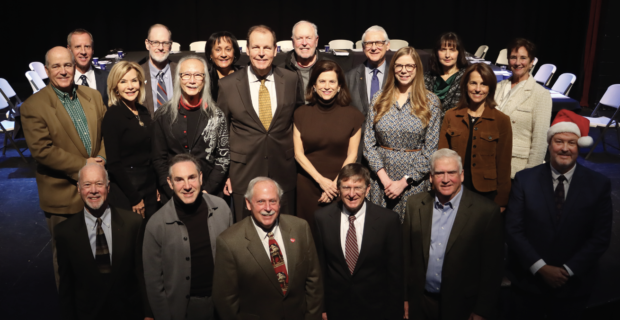
Unbeknownst to them, a conversation relevant to their well-being was about to unfold as a dynamic group of approximately two dozen philanthropic leaders gathered on campus for Ingram’s 25th annual Philanthropy Industry Outlook assembly.
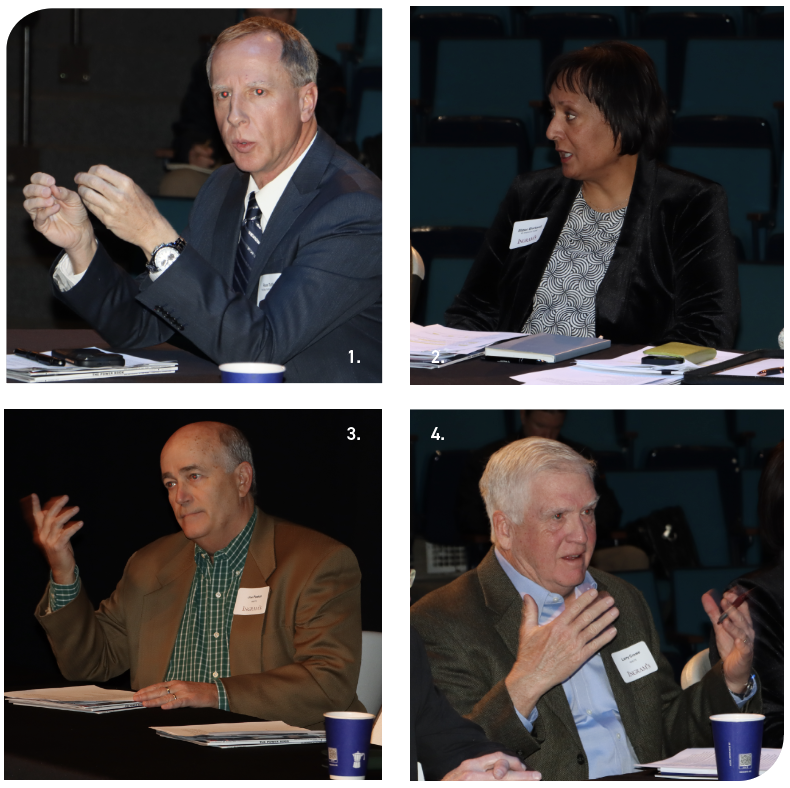
Hosted by Rockhurst High School President David Laughlin, who served as wingman to Mike Brown of Euronet Worldwide as assembly chairs, the session provided an unfiltered platform for non-profit executives, foundation directors, educators, retired professionals turned advocates, entrepreneurs, and individual donors to exchange ideas, voice concerns, and explore solutions.
The conversation’s breadth encompassed a wide array of causes, from childhood education and senior care and homelessness prevention, human-trafficking awareness, arts endowment, affordable housing initiatives, community center sustainability, and beyond. Its depth was revealed through recurring motifs of resource scarcity, demographic urgencies, the skewed influence of mega-donors on national statistics, the ripple effects of dwindling public funding, the ongoing debate between measurable outcomes and flexible support, the imperative for enhanced communication strategies, and the transformative yet perilous potential of artificial intelligence in the non-profit space.
It was a lot to take on in a two-hour window. But those at the table delivered, with an emphasis on inclusivity that set a collaborative tone, allowing voices from small, grassroots operations to resonate alongside those from established institutions, fostering a dialogue that was both introspective and forward-looking.
Christmas Wishes
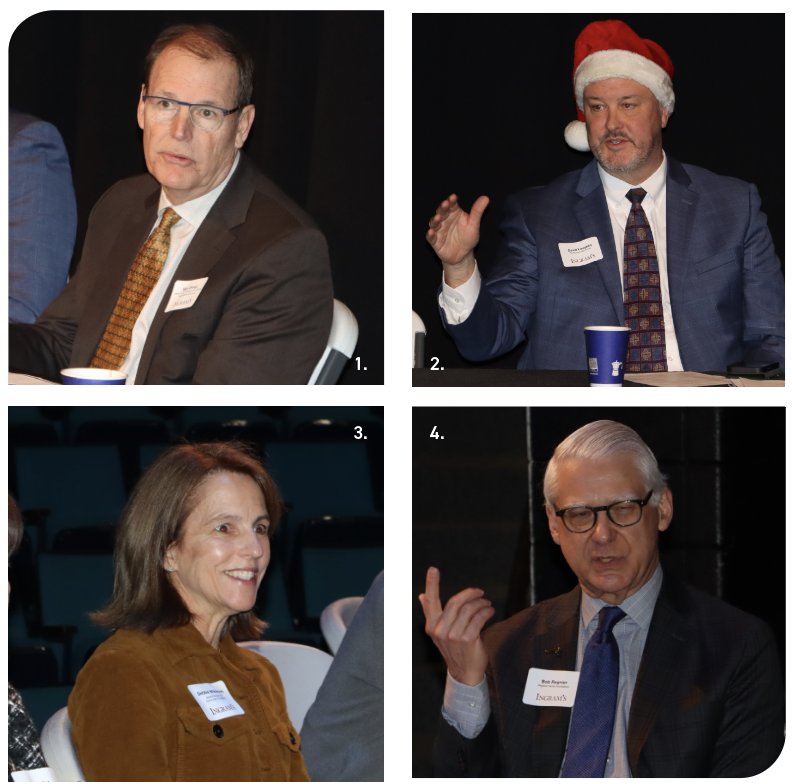 Considering the holiday timing, it seemed appropriate to kick off the discussion by asking each attendee to articulate a concise “philanthropic Christmas wish,” a creative exercise that immediately surfaced individual passions and systemic pain points. These consolidated responses painted a vivid picture of a sector grappling with underfunding and untapped potential while yearning for equity and efficiency.
Emma Brooke of Global Prairie—recently recognized as the No. 1 Benefit (B) Corporation on the planet–expressed a desire for greater support for homelessness initiatives: “The thing I’m most wanting this year is for folks to contribute to organizations that help folks experiencing homelessness in our community. That’s hard every time of year, but especially now in the winter. So that’s my wish.” Debbie Wilkerson, President and CEO of the Greater Kansas City Community Foundation, focused on donor activation: “My wish for them is that they make sure they start granting in July,” rather than waiting for the inevitable end-of-tax-year deluge.
Janet Baker of KC Shepherd’s Center highlighted the widespread neglect of older adults: “I would say that I would like to see more equity in philanthropy for seniors, the fastest growing population, the fastest growing homeless population, and yet somehow continually get about 1 percent of the philanthropic pie, both locally and nationally.” Russ Tuttle of the Stop Trafficking Project targeted digital dangers: “My wish is that we would have more opportunities to end the exploitation of students based on their online behavior because with 100 percent of students who are exploited for sex, it all starts through their cell phone.”
Kar Woo, founder of Artists Helping the Homeless, sought expansion into underserved areas: “I’m actually working towards the program project in Independence because Independence is the city that has the least number of services in comparative, relative terms. So I’m hoping that I can put this project together sometime next year.” As a business owner, Joe Poskin shared the results of an innovative employee program: “We started an automated savings and lending program at our business for our employees,” which helped those on his team eliminate the need to seek out payday lenders. “In my Joe 2.0, I’d like to bring that outside of our businesses and get it spread not only in Kansas City, but around the world, quite frankly.”
David Laughlin emphasized relational foundations: “My wish would be a growing sense of trust in and among all of us in a world where a kind of cynicism and a lack of trust seems to be growing. I think especially the trust between philanthropists and non-profits.”
Mike Brown, who would later in the day be honored along with wife Millie as Ingram’s Philanthropist of the Year, critiqued national patterns: “Even though charitable giving is up after inflation, maybe 3 percent this year in the United States, that’s driven mostly by these mega-donors, as opposed to the rank and file.” His wish is that more of that money “would end up in these locales and do the kinds of things that everybody around this table asks for. I’m not quite sure if we in Kansas City are beneficiaries of those donors, and without them, actually, charitable giving would be down.”
Retired banker Bob Regnier, who says the region has made some progress with home affordability, would like to see more improvements there, but said that if public funding can’t help close the housing gap, non-profits would have to step up to do it.
These wishes, while personal, collectively underscored a call for diversification of funding sources, recognition of overlooked demographics, and mechanisms to foster deeper donor engagement—themes that permeated the ensuing debate.
National Giving Trends
Mike Brown transitioned the discussion to a broader topic, posing a pivotal question: “Nationwide giving is up this year, adjusted for inflation. It’s up because of the mega donors, but it’s not necessarily up in our local. Does anybody know of local outreach or charities that have been recipients of any of this money from these mega donors that we read about all the time?”
Janet Baker provided a grounded response, drawing from headline-making charitable donations by MacKenzie Scott, ex-wife of Amazon founder Jeff Bezos: Of the $250 million Scott distributed to non-profits across the country, Baker said, “We had five organizations in Kansas City that each received $1,000,000 of those unrestricted grants.” But of the 250 organizations that benefitted from Scott’s largesse, “not a single senior serving nonprofit received funds nationally.”
Brown analyzed the numbers further: “Proportionately to our size, if you think about it, that’s five out of 250. That’s ranked 40th in metropolitan size, so I guess that’s maybe the proportion.”
Later, Brown noted a concerning shift: “The biggest growth, which is well over 10 percent this last year, was to think tanks and politically connected organizations to push their theories,” he said. “The biggest donor groups to those kinds of recipients are donor-advised funds.” Debbie Wilkerson, whose team at the Greater Kansas City Community Foundation oversees a great many of those types of funds, countered potential misconceptions, given the regulatory structures around giving: “We have the benefit of saying only grants can go to 501(c)(3) public charities. Hiding money for political activities, I promise you that’s not true because it’s not possible.”
The group acknowledged that while Kansas City garners some benefits from high-profile philanthropy, the heavy dependence on mega-donors introduces instability, as local “rank and file” contributions lag. This disparity forces non-profits to compete for shrinking slices of a pie dominated by a few large players.
The Emerging Senior Crisis
 The conversation on seniors revealed profound depth, with Janet Baker issuing a dire forecast: “I hate to say this, but there’s a freight train coming,” she cautioned, “to the extent that we do not recognize and support keeping older adults in their home. There’s no place for them to go.” She’s particularly concerned that, with Kansas City hosting 2026 FIFA World Cup games and drawing visitors from around the world, short-term rentals are going to skew rents much higher next summer. “Fifty percent of the 3,000 seniors we serve rent,” she said, “and 70 percent are low income, most living on $20,000 a year. So there’s already a trend to evict renters and to turn those properties into short-term rentals for the World Cup. We still have the chance to invest in the type of programs that organizations like KC’s Shepherd Center provide to keep seniors in their homes, but 1 percent isn’t enough.”
On top of that, funding cuts, especially from public sources, are making an impact right now.
Doug Welch of Christmas In October tied that trend to housing: “Corporate partners funding is getting cut, so they’ve done less for us, which means we’ll renovate fewer houses. We won’t go into a house and work on it unless the roof is in good shape. The whole effect of cutting government funding right now becomes a snowball effect.”
Janet Baker detailed funding losses she’s experiencing: “We’ve gone from serving 1,200 homebound seniors in our Meals on Wheels program to 500 because the funding has been cut so dramatically,” she says. “We’ve got the capacity, we’ve got the vans, we’ve got the volunteers, we’ve got the infrastructure for 1,200 or more. I hate to say it’s about the money, but it’s about the money.”
Mike Brown added a street-level observation: “When you see the panhandlers, they’re all kind of my age or older. These aren’t young panhandlers. As you said, these are seniors.”
The speakers portrayed senior services as a “desert” in philanthropy, with funding inadequately matching the demographic surge. Baker’s systemic critique—“the philanthropic community nationwide has ceded responsibility from our communities to the government, and now the cliff happened, and we’re all adrift”—resonated as a call for reclaiming responsibility through private giving.
Youth Exploitation
Russ Tuttle from The Stop Trafficking Project delivered a chilling analysis: “Last year we reached 18,117 students at public school assemblies, and we’re talking to them about online safety, and we do it in the context of we have kids being sold for sex in our community,” he said. “That’s a harsh reality. We know historically, every major event, sporting event or whatever, when the world comes to a community, sex trafficking comes too. When we stop and realize that, it’s not about a creepy vehicle and an abduction. Kids are not being abducted off the streets. It’s about life online and seduction.”
The No. 1 issue his organization is facing “is teenage boys taking their clothes off, sending naked pictures to someone they think is a female on the other end, and it’s someone looking to exploit them. Sex extortion has exploded 18,000 percent from 2022 to 2024.”
He advocated prevention: “The first step in dealing with sex trafficking around the World Cup is not identifying the victims. No, the first step is making sure they’re never victimized in the first place.” The top target for that activity: “Our kids 18 and under.”
That’s why he shares hope through education: “We’ve done school assemblies throughout Kansas and Missouri, reaching over 140,000 kids since 2018. When you tell kids the truth about this issue and what’s actually happening online, they step up. So we as adults aren’t giving kids enough credit.”
The group explored intersections with poverty, such as a 13-year-old providing sexual favors so she can buy something to feed her siblings, illustrating how online seduction exploits economic desperation. One participant suggested amplification: “Your mission is all about education. What we need to do is find a way to help you be in auditoriums like this everywhere so they can hear.”
Public Funding and Strain
Participants repeatedly detailed the cascading impacts of reduced government support. Jo Weller, who runs the Brown Family Foundation, addressed its work with private and charter schools: “We primarily work with K-12, and we do feel that education is a pathway for change,” she said. “The crises are happening and some of the heaviest hit are in schools where the resources were diminished to begin with. They’re really dependent on philanthropy to help them backfill, and they’re having really difficult conversations because the budget got changed on them without a lot of notice.”
Larry Crowe, speaking for the Whatsoever Community Center, said, “Jackson County supplies a certain amount of money, but next year is totally uncertain as to what they’re going to do for us. We have increased donations by making it as real as possible to the local community.”
The consensus was that these cuts force non-profits into survival mode, reducing capacity and exacerbating the very problems they aim to solve.
Janet Baker’s broader critique—“Over decades the philanthropic community nationwide has ceded responsibility from our communities to the government…now the cliff happened, and we’re all adrift”—underscored the need for philanthropy to reclaim ground lost to government reliance.
Giving Models
The evolution toward outcomes-based philanthropy drew praise for accountability but criticism for rigidity. Mike Brown credited the Gates Influence: “When Bill and Melinda started their foundation, they actually changed philanthropy in the country,” he said. “Outcomes-based giving, as opposed to everybody wants unrestricted (donations).”
The foundation he and his wife have created measures academic results, metrics that tell them whether the schools they’ve supported are doing a good job, but perhaps more importantly, whether those programs really work, and can be replicated in other schools.
However, operational constraints frustrated many. “Typically, philanthropists want to pay for the food, and they just assume that it’s magically going to appear on someone’s doorstep,” Baker lamented. “The trend that I’ve seen is away from any kind of support for marketing. How do we get our word out? How do we get to your point? How do we get the word out that our programs and services are available if no one will fund the communication necessary to do so?”
Larry Crowe ventured that “Everybody wants you to run a program where they want to direct where the money goes, and you’re saying, ‘I’ve got to keep the lights on.’
Encouragingly, Debbie Wilkerson observed a positive shift, with the foundation hearing more discussions around unrestricted giving.
The group agreed that while outcomes ensure impact, unrestricted funds are essential for sustainability, with trust as the bridge.
Connecting with Donors
Effective communication was positioned as a linchpin for growth. Jeanette Prenger of ECCO Select offered this: “A lot of it has to do with messaging. They can use that funding to support their overhead, their marketing and communications. They can also attract higher wealth, maybe executives from corporations to participate and understand their vision and mission.” But non-profits must make giving more accessible for prospective donors, especially impulse donors. “It has to be really easy,” she said. “They can point their phone, get a QR code and donate online. If it’s not easy, they end up on a web page that doesn’t take them anywhere, or they can’t accept their credit card. So it doesn’t happen.”
Mike Brown asked whether the non-profits at the table all had a website QR code that allowed for instant donations. “Reduce the friction between when somebody is first exposed to what you do and the great things that you’re doing, then either becoming a partner, a donor, or something.” And for those strapped for cash to hire staffing, “Grabbing some college and high school kids as interns into your organization would be a great thing for everybody.”
Generational outreach resonated with Emma Brooke: “Trends in terms of how much purpose matters, you look at Gen. Z, or you look at Millennials. For these generations, purpose is more important than any generation before. For them, they live online. What are they exposed to through social media?” That, she says, makes outcome-based messaging vital. “Tell a story about giving that’s much more than one specific thing.”
Indirectly, participants emphasized diversifying beyond seeking out the same people and organizations as donors and leveraging local stories to create greater impact with prospective donors.
The AI Dynamic
Artificial Intelligence sparked nuanced exploration. “For smaller not-for-profits, it can help you take a look at some of your potential donor lists, and AI can go through very quickly,” said Jeanette Prenger. “Use AI to improve your operational efficiencies and help with your messaging.”
Mike Brown said, “AI could help with that to some extent, but the counter to the reality is it will cause an enormous loss of jobs. That’s the reality. It’s just like the feds that cut everybody’s funding, that’s a reality too.”
“At Global Prairie,” said Emma Brooke, “we think about the combination of AI, human intelligence, and data. AI left to its own devices has concerns, bias, and hallucinations.” Still, she says, “it’s an incredible tool.”
Russ Tuttle again warned of dangers lurking, with “52 percent of American teenagers every week engaging with an AI companion.” They’d rather talk to an AI companion than an adult, he said, “because there are no boundaries there.”
David Laughlin offered optimism from education: “Teachers call AI a great tutor, but a poor student,” he said. Encouragingly, he cited the example of a Rockhurst graduate who wrote a program for a local non-profit that used AI to dramatically increase the number of grant applications it could generate.
The consensus was that AI promises efficiency in donor targeting and operations but demands safeguards against bias and exploitation, especially for youth.
Collaboration and Innovation
The roundtable captured a philanthropic sector at a pivotal moment—facing funding cliffs, demographic surges, and digital threats, yet bolstered by shared commitment. Mike Brown’s summation resonated: “Everybody’s lives around the table are going to be tougher over the next three to six years with less federal funding. It all comes down to messaging.”
Through their direct observations and indirect insights, the discussion revealed Kansas City’s leaders as resilient, urging broader participation, sharper communication, and ethical use of AI to meet escalating needs.
PUBLISHED DECEMBER 2025